

BEAVER CREEK, COLO. Gold has more than doubled since early 2022 even as U.S. bond yields climbed, a break investors at the Precious Metals Summit say may signal bullion is regaining a monetary role. But the money is reaching junior miners unevenly
Front-month COMEX gold futures ended Sept. 24 at $4,263 (C$6,029) per oz., 20% below their Jan. 29 record settlement of $5,318.40, according to Dow Jones market data. The nominal 10-year U.S. Treasury yield reached 5.2% the same day, its highest since 2007, according to the U.S. Treasury.
“It used to be that rising yields were poison for gold,” Sprott (TSX, NYSE: SII) Senior Portfolio Manager John Hathaway told a summit panel moderated by Northern Miner Group President Anthony Vaccaro. “That hasn’t been the case for quite some time, and again, I think it shows cracks in the level of trust in bonds as a safe haven.”
The divergence raises the question for mining investors: will capital now concentrated in bullion and large producers move into explorers and developers? Juniors offer greater leverage to discoveries and rising metal prices, but geological, financing, permitting and dilution risks can erase that upside. Interviews at Beaver Creek show capital still favours advanced projects and established teams over grassroots exploration.
Bond break
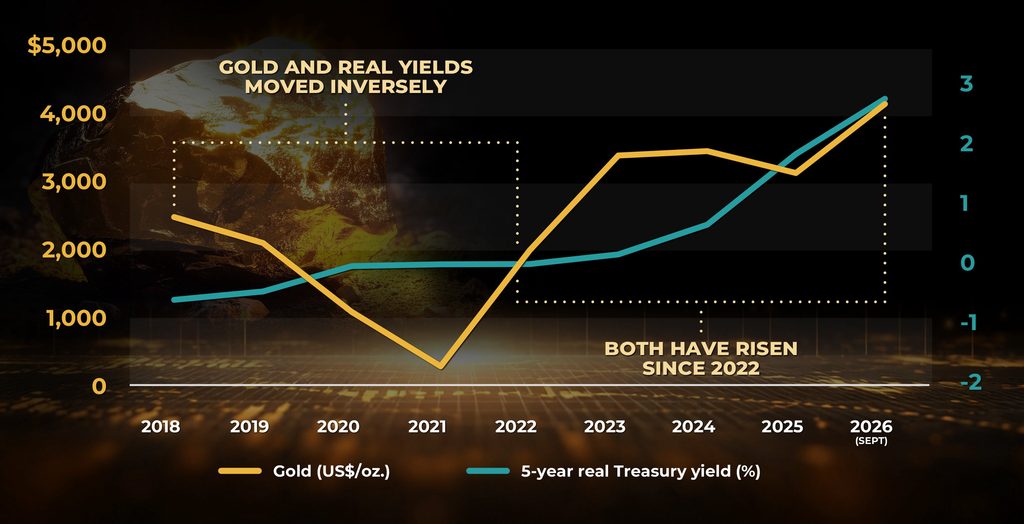
For almost two decades, gold generally fell when inflation-adjusted Treasury yields rose because bonds offered a real return while bullion paid none. That relationship held from Jan. 2003 through Feb. 2022, according to data presented by Vaccaro from Bloomberg. Since March 2022, gold and five-year real Treasury yields have risen together.
Ronald-Peter Stöferle, managing partner of Liechtenstein-based fund Incrementum, which manages about €500 million ($570 million), traced the change to Western governments freezing Russian central-bank reserves after Russia invaded Ukraine in 2022. Central banks, particularly in emerging markets, began treating gold as a monetary “Plan B” outside the U.S.-led financial system, he said.
Central banks bought a net 863 tonnes of gold last year, according to the World Gold Council. That was 21% less than in 2024 but well above the 2010-21 annual average of 473 tonnes.
“Central banks continue to buy on dips. They’re just a steady, long-term strategic buyer,” Canadian Mining Hall of Fame member Frank Giustra told The Northern Miner. “The general public hasn’t really been exposed to the gold market yet. Not in ways that I’ve seen through my 45 years in this business.”
Hathaway, whose firm manages $55.3 billion, said further rate increases that erode bond values, an equity selloff or trouble in private equity could weaken confidence in conventional portfolios and drive capital into gold.
Incrementum’s 2026 “In Gold We Trust report” puts the global bond market at about $140 trillion and investment gold at about $14 trillion. A 2% shift from bonds would amount to nearly $3 trillion, about one-fifth of that gold pool.
“The gold market doesn’t have the capacity to absorb those flows without a big price move,” Hathaway said.
Kai Hoffmann, lead portfolio manager at Germany-based Kamavest Asset Management and CEO of junior financing tracker Oreninc, sees a fiscal bind underpinning bullion.
“You raise interest rates, your debt payments explode,” Hoffmann said. “If you don’t raise interest rates, inflation explodes.”
Watch a video of the panel here:
Capital divide
Any flow into mining remains uneven. Global gold exploration budgets rose 11% to $6.15 billion in 2025, S&P Global Market Intelligence said in a June report. Major producers increased spending 15% to $3.5 billion, or 57% of the total.
The industry directed more than half of its exploration spending to lower-risk programs around existing mines. Grassroots exploration received a record-low 18% share. S&P said fundraising by junior and intermediate companies improved, but much of the money went to late-stage development rather than new discoveries.
The imbalance matters because major producers still rely on juniors to find and advance deposits after underinvesting in exploration for more than a decade, Giustra said.
“I think most of the future gold discoveries are going to come from juniors,” he told The Miner.
Oreninc’s coverage universe of smaller companies is on pace for a record fundraising year, Hoffmann said, but explorers still have a harder time raising money than developers.
“There is money available, but I think it’s going towards the pre-development stories,” he said.
Vancouver-based Amarc Resources (TSXV: AHR; US-OTC: AXREF) shows that explorers with established discoveries can still attract institutions. The B.C. copper-gold explorer closed a fully subscribed C$20-million private placement last month. Chair Robert Dickinson said large Canadian and U.S. institutions participated and the financing proceeded more efficiently than earlier raises, although the quality of Amarc’s projects likely helped.
Yukon gold explorer Banyan Gold (TSXV: BYN; US-OTC: BYAGF) closed a C$46.5-million financing in May, bringing its treasury to about C$75 million. Late last month, it announced another C$58-million raise, including a C$20-million commitment from royalty and streaming company Franco-Nevada (TSX, NYSE: FNV).
Advanced projects have more lenders to choose from. Meridian Mining (TSX, LSE: MNO; US-OTC: MRRDF) CEO Gilbert Clark said debt funds, commercial banks and commodity traders have larger sums available but haven’t relaxed their risk tests. Meridian still needs to secure $377 million for its Cabaçal copper-gold project in Brazil.
Equity gap
The industry’s valuation discount is clearest among established producers. The ratio of the Philadelphia Gold and Silver Index to bullion stood at 0.08 on June 30, less than half its long-term average of 0.17, according to Bloomberg data Vaccaro showed.
Companies in the NYSE Arca Gold Miners Index also traded at 5.1 times enterprise value to earnings before interest, taxes, depreciation and amortization, compared with 15 times for the equal-weighted S&P 500.
Those comparisons mostly cover producers, not early-stage explorers. Institutions entering gold equities would probably begin with large, liquid companies before smaller, specialized pools moved into developers and explorers, Hathaway said.
“Junior companies bring in potential risks of all kinds that you have to judge,” he told The Miner. “But the large companies, I think, are a great place for somebody who doesn’t have exposure to start.”
Developers can offer greater leverage as higher gold-price assumptions lift projected project values and returns. Explorers can deliver larger gains through discovery but produce no cash and depend on repeated financings, leaving returns vulnerable to drilling results and dilution.
Higher prices, however, can revive marginal projects alongside good ones, Hoffmann warned.
Missing buyers
Broader institutional flows haven’t reached juniors at scale. Hoffmann said much of the market still consists of mining specialists trading among themselves, despite Oreninc’s strong fundraising tally.
“The Nasdaq, the S&P, they’re all sitting at record highs,” he said. “There’s no need to chase returns elsewhere.”
Vancouver-based mining investment consultancy Cupel Advisory Director Neil Adshead said fund size itself keeps many generalists out. A manager overseeing $5 billion can’t put meaningful capital into a $50-million junior because its shares are too small and illiquid.
Junior funding instead comes largely from retail and high-net-worth investors and producers, Adshead said. Through his work with Centerra Gold (TSX: CG; NYSE: CGAU), he has helped deploy about C$40 million across six juniors.
“I don’t think there’s any shortage of money at the moment for juniors,” Adshead said.
Utah-based economic geologist and junior-mining investor Brent Cook identified another barrier: investors unfamiliar with geology can struggle to distinguish economic projects from promotional stories. He has seen companies valued at C$50 million to C$300 million raise tens of millions despite projects he considered weak.
Years of dilution, missed targets and value-destructive acquisitions have also left investors wary. Stöferle said miners must continue to rebuild trust by meeting promises and protecting per-share value.
Bull cases
A broad market decline could drive capital into gold while initially hurting juniors dependent on risk capital. Denver-based Crescat Capital founder and CEO Kevin Smith acknowledged that junior gold shares could fall with the wider market, though he expects them to outperform over the short to medium term.
Hathaway said gold could reach $10,000 per oz. within two years if a financial-market breakdown triggered what he called a “Pavlovian” response from monetary authorities — an automatic return to stimulus. A more gradual monetary reset could take about five years, he said.
Crescat’s Smith, with about $600 million in assets under management, sees a path to $20,000 gold within about four years. He said the global monetary base has expanded more than 7% annually for almost a decade, while above-ground gold stocks have grown about 1.5% a year for roughly a century.
Neither forecast guarantees junior-mining gains. A higher gold price can strengthen project economics and access to capital, but it can’t repair poor geology, weak management or an inflated share count.
“The juniors, you need to really understand what that company is looking for,” Cook said. “And you’ve got to understand what success looks like versus failure.”
Be the first to comment on "Beaver Creek: Gold’s bond break puts juniors in play"