
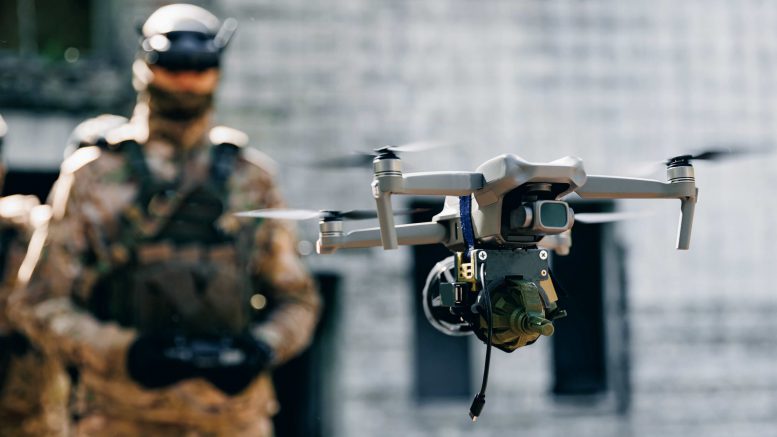
Drones deployed in the Russia-Ukraine war account for an estimated 4% of global germanium demand, adding pressure to a small critical minerals market dominated by China, according to BMO Capital Markets.
About 15 million drones are expected to be deployed in the conflict this year. Governments and military alliances have pledged about $150 billion (C$208 billion) for drone and counter-drone capabilities since 2025, with roughly half appearing committed and about a third earmarked for counter-drone technology, BMO estimates in a report on Tuesday.
“It is safe to say that the world has entered the era of mass drone warfare,” BMO commodities analysts George Heppel and Helen Amos said. “Mass drone mobilization represents arguably the biggest technological shift in modern warfare in decades.”
The scale is already visible beyond BMO’s estimates. Ukraine aims to produce more than seven million drones this year, up from four million in 2025, according to its defence ministry. Drones now account for more than 80% of enemy targets destroyed by Ukrainian forces, BMO said, citing the ministry.
NATO in July committed more than $40 billion over five years to counter-drone capabilities and aims to train five times as many drone operators by the end of 2027.
The spending adds another source of demand for commodities already considered strategically important for electric vehicles, semiconductors, telecommunications and other advanced technologies. The potential vulnerability is particularly acute because markets for gallium, germanium and heavy rare earths are small and their processing is concentrated in China.
China choke point
Gallium nitride is used in high-frequency and power semiconductors important to communications and radar systems, while germanium is used in infrared optics, fibre optics and semiconductors. Rare-earth permanent magnets provide the lift and torque in electric drone motors.
The Washington, D.C.-based Center for Strategic and International Studies identified gallium-nitride chips and rare-earth magnets among the principal chokepoints in the drone supply chain in a December study.
An average drone operating on the Ukrainian battlefield contains 46 grams of neodymium-iron-boron magnets, 0.1 gram of gallium and 1 gram of germanium, BMO estimates. The impact on overall demand is relatively small for magnets and gallium, but more significant for germanium.
Counter-drone systems create demand of their own. A well-placed drone costing a few hundred dollars can threaten civilian infrastructure worth billions, prompting governments to invest in layered defences, BMO said. Gallium and germanium are important inputs, alongside rare earths including gadolinium, yttrium, ytterbium and samarium.
China produced 98% of the world’s primary refined gallium, 77% of refined germanium and 68% of mined rare earths in 2023, according to a U.S. Geological Survey study released in June.
That dominance has increasingly become a security concern. Beijing imposed export licensing requirements on gallium and germanium in 2023 and banned exports of both metals to the United States in December 2024. It suspended the U.S. ban in November 2025 until Nov. 27 this year.
The disruption was nevertheless significant. U.S. imports of germanium metal fell an estimated 67% last year, USGS said.
Wartime drone consumption likely contributed to germanium’s price rise to more than $11,000 per kg from a historical average of about $2,000, BMO said.
Gallium presents a similar problem. China accounted for 99% of primary low-purity gallium production last year, according to USGS, while the United States produced none and remained entirely dependent on imports for reported consumption.
Canada supply
The Western push to loosen those dependencies could benefit several Canadian-listed companies.
Teck Resources (TSX: TECK.A, TECK.B; NYSE: TECK) signed an agreement with Ottawa in July supporting as much as C$850 million of potential investment at its Trail smelting and refining complex in British Columbia to expand germanium, gallium and antimony production.
Canada Growth Fund could invest as much as C$400 million directly into the facility. The plan could double Trail’s existing germanium and antimony production capacity and add gallium production, while giving the federal government potential offtake rights to part of the output.
Trail is already a commercial producer of germanium, recovered as a byproduct from zinc concentrates.
Rio Tinto (LSE, ASX, NYSE: RIO) is pursuing another potential Canadian source. The miner plans to start a gallium pilot plant next year at its Complexe Jonquière in Saguenay, Que., using material already present in the bauxite processed by its Vaudreuil alumina refinery.
A planned demonstration operation could produce as much as 4 tonnes of gallium annually. Rio says a subsequent commercial-scale plant could reach 40 tonnes a year, about 5% of current global output.
World primary gallium production totals only a little more than 700 tonnes annually and currently comes entirely from outside North America, Rio said.
Heavy rare earths
Heavy rare earths such as dysprosium and terbium present another challenge. They are used in high-performance permanent magnets, particularly where magnets must retain their properties at elevated temperatures.
Neo Performance Materials (TSX: NEO; US-OTC: NOPMF) commissioned a small-scale heavy rare-earth separation line at its Silmet facility in Estonia in April. It has produced separated dysprosium and terbium process solutions from mixed rare-earth carbonate feed entirely within Europe.
Neo also supplies refined gallium products, giving it exposure to another important drone material, BMO said.
The Toronto-based company on Aug. 31 also announced an agreement with France’s Carester to secure heavy rare-earth oxides for its European magnet manufacturing operations in exchange for recycled magnet material and separation feedstock.
MP Materials (NYSE: MP) is targeting the drone industry through Project Swarm, which pools demand and standardizes specifications to support domestic rare-earth magnet supply. The company said in August it had signed agreements with several U.S. and allied customers. BMO highlighted the initiative alongside MP’s magnet materials business and strategic rare earths exposure.
Developer Aclara Resources (TSX: ARA) is meanwhile advancing the Carina ionic-clay rare earths project in Brazil. A feasibility study outlines average annual production of 156 tonnes of dysprosium, 27 tonnes of terbium and 1,191 tonnes of neodymium-praseodymium over an 18-year mine life, with operations targeted for 2028.
Consumption
Modern warfare also consumes drones differently from most civilian technologies. Rather than remaining in service for years, inexpensive battlefield drones are frequently destroyed after a single mission, requiring factories to continually replace them.
BMO also identified Ivanhoe Mines (TSX: IVN; US-OTC: IVPAF) as offering indirect exposure through its germanium- and gallium-bearing Kipushi deposit in the Democratic Republic of Congo and its potential role in future U.S. critical mineral supply chains.
Ivanhoe founder Robert Friedland illustrated the difficulty of recovering metals consumed in warfare during an April interview at the FT Commodities Global Summit in Lausanne, Switzerland.
“War is like really stupid, you know, because it chews up astronomical amounts of metal that’s frequently not recyclable,” Friedland said. “When a shell blows up in Ukraine, boom, the copper in that shell is scattered all over hell and gone. It’s very hard to recycle it.”
Be the first to comment on "Drone wars deepen West’s critical minerals squeeze"