
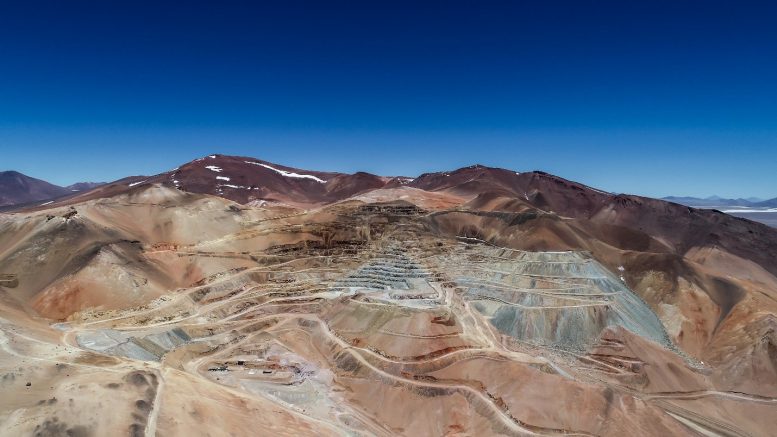
Kinross Gold (TSX: K; NYSE: KGC) has raised the projected cost of its Lobo-Marte gold project in Chile by nearly two-thirds to $1.8 billion (C$2.5 billion), though the post-tax net present value is still estimated at $4.3 billion.
The project, 160 km east of Copiapó, the Atacama region’s capital and 50 km from Kinross’ La Coipa and Maricunga mines, is to produce about 350,000 oz. a year for 15 years at all-in sustaining costs of about $1,000 per ounce. Kinross estimates a 26% internal rate of return and 2.3-year payback at $4,100 gold.
“We completed a high-level refresh of our feasibility study economics to account for inflation since 2021 and further enhancements of the execution strategy,” Chief Technical Officer Will Dunford said on Thursday’s earnings call. “The combination of the low mining cost, low processing cost, high heap leach grade and the resource size are what make this project a central focus in our grade enhancement strategy.”
Lobo-Marte is to equal almost one-fifth of Kinross’ present annual output and extend its Chile business into the 2040s. The capital estimate came in 10% below Scotiabank’s model and projected mine costs were about 30% lower, making the update slightly better than expected, mining analyst Tanya Jakusconek said in a Thursday note.
BMO Capital Markets cut its Kinross target to C$49 from C$51 after raising its Lobo-Marte capital estimate, though it kept an outperform rating and said the project still supports significant valuation upside.
Kinross shares fell 2.2% to C$31.99 by late Thursday morning in Toronto.
Cost increase
Inflation accounts for more than $400 million of the increase from the 2021 estimate, Dunford said. Kinross added about $100 million after deciding to buy mining equipment rather than reuse machinery from its nearby Maricunga project, which it now wants to preserve as a separate development option.
Changes to construction planning and higher indirect costs account for much of the remaining increase. Kinross raised the project contingency to 19% from 14% because four years have passed since it completed the detailed estimates behind the original study.
The new estimate includes $1.1 billion in direct spending and about $700 million for indirect costs and contingency. Process facilities make up the largest single item at $490 million, followed by $410 million for site work and infrastructure.
The update refreshes the economics of the 2021 feasibility study rather than replacing its mine plan. Kinross kept the former pit designs and reserve base to avoid delaying an environmental application built on years of baseline work. It plans to issue a firmer cost estimate after completing detailed engineering.
The economics remain strong under a lower metal-price case. At $3,500 gold, Kinross estimates a $3.2-billion net present value, 22% return and 2.7-year payback.
Mine plan
Lobo-Marte contains proven and probable reserves of 160.7 million tonnes grading 1.3 grams gold per tonne for 6.73 million contained ounces. Indicated resources stand at 120.8 million tonnes at 0.71 gram per tonne for 2.75 million oz., while inferred resources total 32.9 million tonnes at 0.63 gram for 670,000 ounces.
Kinross plans to mine the Marte and Lobo open pits in sequence using trucks and shovels. The operation would process 161 million tonnes of ore through a three-stage crushing and heap-leach plant rated at 35,000 tonnes per day.
The company forecasts gold recovery of 69%, a waste-to-ore strip ratio of 2 to 1 and peak mining of 50 million tonnes a year. Processing would cost an estimated $12.30 per tonne and mining $3.25 per tonne. The relatively high grade for a heap-leach operation drives much of the project’s estimated margin.
The site would require a 75-km access road, a 60-km power line and a 40-km pipeline linked to a well field that supplies Kinross’ La Coipa mine. The design calls for renewable grid power, electric shovels and covered conveyors to curb dust.
Growth scope
The initial plan would recover 4.6 million oz., leaving much of the project’s resource outside the reserve pits. Kinross designed the 2021 shells at a $1,200 gold price, well below the price used in the refreshed economics.
Both deposits remain open at depth, while indicated and inferred resources outside the pits could support wider shells and a longer mine life. Kinross plans to defer that work until after production begins because the permitted base plan already supports mining well into the 2040s.
Permit path
Chile’s Environmental Assessment Service accepted Lobo-Marte’s environmental application for review in April. Kinross expects the process to take two to three years, followed by construction near the end of the decade and first production in the early 2030s.
The company expects to fund the three-year build from operating cash flow. Kinross held $2.7 billion in cash, $1.9 billion in net cash and total liquidity of about $4.4 billion as at the end of June 30.
Great Bear update
Elsewhere in the portfolio, Kinross is also reporting construction progress.
At Great Bear, near Red Lake, Ont., Kinross on Monday completed the first blast for its exploration decline as surface construction reached 93%.
Detailed engineering for the main project is about halfway complete, major equipment contracts have been awarded and permitting remains on track for first production in late 2029.
Quarterly results
Kinross on Wednesday reported adjusted second-quarter profit of 71¢ a share. That beat Scotiabank’s 66¢ estimate, though the bank attributed the difference to lower taxes and called the quarter “neutral” for the shares.
Kinross generated $726.8 million in attributable free cash flow during the quarter as a 37% rise in its realized gold price offset lower production and higher costs.
Output fell 4% from a year earlier to 477,879 oz. gold and 761,479 oz. silver., while all-in sustaining costs rose 22% to $1,821 per ounce.
Kinross maintained its forecast to produce 2 million attributable gold-equivalent oz. this year, with silver converted to gold at average spot prices, at all-in sustaining costs of $1,730 per ounce.
Be the first to comment on "Kinross’ Lobo-Marte cost jumps 67% as NPV triples"