
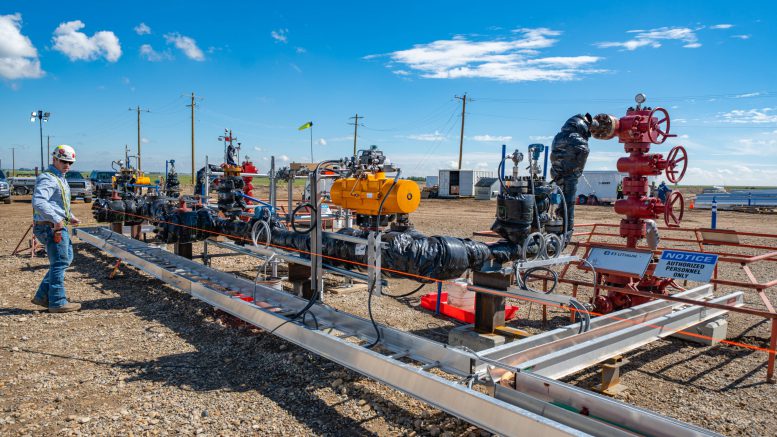
E3 Lithium (TSXV: ETL; US-OTC: EEMMF), whose total holdings represent Canada’s biggest lithium resource, plans to be shovel-ready, drive bank-led funding talks in earnest and reach a final investment decision by this time next year.
The company is targeting first output by mid-2029 of 12,000 tonnes a year of battery-grade lithium carbonate in the first stage of its Clearwater project, about 130 km south of Calgary where E3 is based.
Capital costs are expected to be lower than a 2024 prefeasibility study’s (PFS) forecast of $2.5 billion (C$3.53 billion) for a 30,000-tonne-per-year build-out because E3 is removing plans for a downstream hydroxide plant.
E3’s push to be Canada’s first commercial scale battery-grade lithium producer comes as the metal’s prices recover from a two-year slump that paralyzed investment across the sector. Governments in Canada, the United States and Europe, spooked by China’s control of battery mineral supply chains, have begun propping up domestic supply through grants, stockpiling and price support.
“We’re getting inbounds all the time for requests for proposals for lithium,” CEO Chris Doornbos said in a June phone interview. “The real bank financing for the debt component of this facility will probably start in the new year as we start to nail down offtake.”
Offtakes
Doornbos described E3’s planned capital structure as analogous to a midstream pipeline: roughly 60% to 70% debt secured against long-term offtake contracts, with the remainder raised as project-level equity. Potential equity sources span strategic investors seeking Alberta lithium exposure, the Canada Growth Fund, and funds in Japan or Europe tied to offtake commitments.
E3 says it is fielding requests from automakers, cathode producers, battery makers and mining and energy companies, and expects a handful of major offtake deals to unlock a broader rush of capital into North American lithium development.
“There’s significant interest right now in trying to supply domestic sources of ex-China lithium,” he said. Doornbos said he has traveled to India and plans a Japan trip to speak with potential customers.
The road to a final investment decision is not without risk. Doornbos acknowledged that lithium spot prices remain an imperfect gauge of what a producer actually gets paid, since the metal trades primarily through private contracts rather than open markets. E3 has yet to sign an offtake agreement, and it has not published a compliant capital cost estimate for stage one alone.
The company does have about C$80 million in federal and provincial support, including a C$36.5-million non-repayable federal grant finalized June 10.
Alberta
E3’s Bashaw District land position in central Alberta holds measured and indicated resources of 16.2 million tonnes of lithium carbonate equivalent (LCE), grading 75.5 milligrams of lithium per litre of brine, according to the June 2024 PFS. The district represents 40% of Canada’s measured and indicated lithium inventory.
The Clearwater project, a 50-year brine production area within Bashaw, holds proven and probable reserves of 1.13 million tonnes of LCE, grading 75.5 milligrams of lithium per litre of brine. Proven reserves for the first five years of operation total 141,200 tonnes of LCE.
Discounted at 8%, the PFS pegged Clearwater’s post-tax net present value at $3.72 billion and its after-tax internal rate of return at 24.6%.
E3’s Garrington district, west of Bashaw, hosts 5 million measured and indicated tonnes at 54 milligrams lithium, according to an initial resource from last summer. It also hosts 300,000 inferred tonnes grading 42 milligrams lithium. E3 has not yet announced plans to incorporate Garrington into the Clearwater development plan.
Alberta’s Leduc Reservoir, a subsurface brine system drilled for decades by the oil and gas industry, underpins both. A March assessment by the Alberta Geological Survey put the province’s total resource at 82.5 million tonnes of LCE, placing it third globally.
“Bolivia, Argentina and then Alberta,” Doornbos said. “And then Chile.”
Demo plant
E3 extracts lithium by flowing Leduc brine through a solid absorbent that selectively captures lithium ions and releases them into a clean solution. The company commissioned the second stage of its demonstration facility June 15. It’s running subsurface brine tests and reservoir production work it says fills a key data gap before a feasibility study due early next year.
A third stage, set to start in July, will deploy a single commercial-scale extraction column, one of 120 that would be needed in the full plant. One column processes 850 cubic metres of brine a day and is rated at 100 tonnes a year of carbonate-equivalent output. The module is on order and expected to be operating this fall, giving E3 a one-to-120-scale preview of its commercial facility.
The process exits at 66% lithium purity, Doornbos said, reducing the downstream cleanup burden relative to hard-rock conversion routes that must strip away a 94% impurity fraction. E3 compares its simplified water-treatment-like flow sheet against the large-scale roasting and blending required to convert hard-rock concentrate into battery-grade product.
Costs
“This [dropping the hydroxide] shift aligns with the growth of lithium iron phosphate battery chemistry versus nickel-rich cathodes, which require lithium hydroxide,” Canaccord Genuity mining analyst Anthony Taglieri said in a June 17 note. “Management expects the phase one capex profile to be significantly lower than the prefeasibility study.”
E3’s preliminary study pegged operating costs at about $6,000 per tonne of lithium carbonate equivalent — on par with Standard Lithium (TSXV: SLI) and Germany’s Vulcan Energy Resources (ASX: VUL), and about a third less than a typical hard-rock operation, Doornbos said. E3 has moved away from incorporating downstream conversion to lithium hydroxide as in the study, he said.
Capital spending runs about 12% above Standard Lithium’s published figure, which Doornbos attributed to higher brine volumes needed. He said the gap falls within the plus-or-minus 30% accuracy range of a prefeasibility estimate, making the two projects “very, very similar in total capex.”
E3 brought in Tom Gear as chief operating officer on June 8, adding a seasoned builder to a management team that also welcomed a new chief financial officer, Brian Newmarch, last year.
Doornbos said he expects to eventually add a president for Canadian operations while he focuses on business development and expansion into the broader battery supply chain, including a partnership with Pure Lithium and exploratory talks in the cathode space.
E3’s goals for early next year mean permits, studies and technical data are to be in place before financing discussions heat up.
“The fact that we’re operating Canada’s only battery grade carbonating today is something that I’m personally very proud of,” Doornbos said. “It’s been a long road to get here, but we’re sort of over that big hump now, and we’re moving all of this forward.”
Be the first to comment on "E3 eyes financing for Canada’s largest lithium play"