
Sovereign Metals (ASX: SVM; LSE-A: SVML; US-OTC: SVMLF) said Wednesday heavy rare earth-rich monazite confirmed in four planned pits at its Kasiya project in Malawi could open a third revenue stream from material now destined for tailings. Shares rose.
Those pits fall in the definitive feasibility study (DFS) defined mine plan based on rutile and by-product graphite alone. Assays for dysprosium-terbium (DyTb) and yttrium oxide ratios in Kasiya’s total rare earth oxide basket came in at 2.5% and 11.8%, compared with 0.4% and 1.7% across the world’s five largest rare earth producers, according to the company. Near-surface samples returned up to 3.1% DyTb and 17.2% yttrium.
“The recovery of monazite could add about $60 million (C$83 million) per annum to EBITDA with relatively little additional operating cost,” John Meyer, an analyst at London-based brokerage SP Angel, John Meyer, said in a note Wednesday. “While the recovery of the monazite adds to the strategic nature of the Kasiya project it will add materially to the project value.”
Using an 8% discount rate, Rio Tinto- (ASX, NYSE, LSE: RIO) backed Sovereign’s DFS last month pinned a pre-tax net present value to Kasiya of $2.32 billion, generating average annual cash flow of $409 million. It didn’t disclose an after-tax NPV. Rio owns 19.9% of Sovereign.
USA Rare Earth’s (Nasdaq: USAR) $2.8 billion (C$3.9 billion) deal to buy last month of Brazil’s Serra Verde rare earths project — which is propped by a 15-year U.S. government-backed offtake with floor pricing — is a sign Western buyers will pay up for non-Chinese supply, Sovereign says.
Sovereign’s shares rose 9% to close at 36.5 pence in London Wednesday. The company has a £239 million (C$443.8 million) market capitalization.
Valuable earth
Permanent magnets that use Dy and Tb perform better at high temperatures in electric drivetrains, wind turbines and defence systems. Yttrium goes into aerospace coatings, radar, lasers and semiconductors. China controls about 95% of Dy and Tb output, Sovereign said.
An independent study values Kasiya’s monazite concentrate at $16,000 a tonne in a base case and $19,000 in a high case, versus an April Shanghai benchmark of $6,142 a tonne for comparable monazite, the company said.
“These results confirm that the monazite-hosted rare earth content first reported in January is present in pits scheduled for the early years of production at Kasiya,” CEO Frank Eagar said in a regulatory filing. “These elements appear to be recoverable from the current tailings stream of our DFS flowsheet.”
The company still has to prove recoveries, saleable volumes and how it will handle uranium and thorium in monazite. It says the mineral sits in the existing non-conductor tailings stream, which means little extra processing is required rather than a new flow sheet.
Graphite advantage
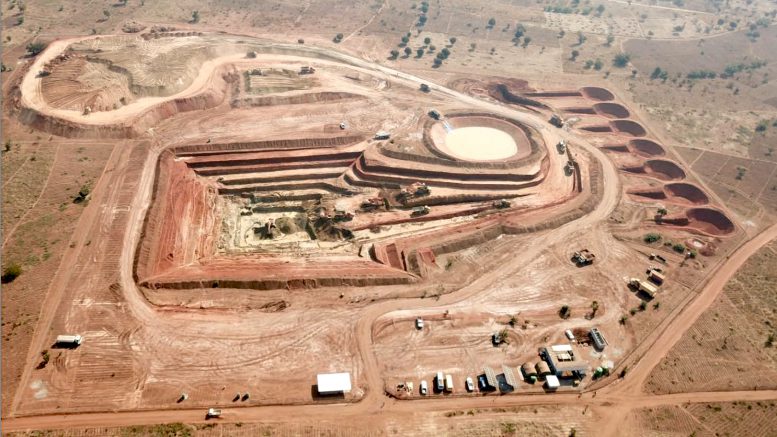
Kasiya is considered the world’s largest known rutile resource. Kasiya hosts an indicated and measured resource of 3.43 billion tonnes grading 0.77% rutile and 1.09% total graphitic carbon for 26.3 million tonnes of contained rutile and 37.3 million tonnes of contained graphite. The reserve totals 536 million tonnes grading 0.95% rutile and 1.56% total graphitic carbon for 5.09 million tonnes of rutile and 8.35 million tonnes of contained graphite.
The DFS pegged steady-state output at an average 246,000 tonnes of rutile and 265,000 tonnes of graphite per year, with the additional cost of by-product graphite estimated at $241 a tonne. Sovereign defines this as the cost to produce and transport 1 tonne of graphite concentrate to port after deducting the share of the total production costs of rutile, which is the mine’s main product.
Since graphite is a by-product at Kasiya, Sovereign says that lets it target graphite below the Chinese weighted average cost of $257 a tonne, producing 96%-98% carbon concentrate and 68% of flakes in medium, large and jumbo sizes.
Be the first to comment on "Sovereign seeks $60M rare earth revenue from tailings in Malawi"