

Colombia’s presidential election this weekend could determine whether one of Latin America’s most underexplored copper frontiers attracts billions in mining investment or sinks deeper into regulatory uncertainty and security turmoil.
The May 31 vote has become a referendum on President Gustavo Petro’s leftist agenda after four years of environmental reforms, tax increases and worsening security conditions that rattled investors across Colombia’s mining and energy sectors.
Senator Iván Cepeda, the candidate aligned with Petro’s Historic Pact coalition, is campaigning to continue the government’s “Total Peace” strategy and energy transition policies, while conservative rivals Paloma Valencia and Abelardo de la Espriella promise deregulation, tougher security measures and stronger support for private investment.
Investors fear Cepeda, the son of a slain communist leader, could deepen state intervention in the economy, loosen fiscal discipline and weaken the independence of Colombia’s inflation-targeting central bank system.
Cepeda has attempted to reassure markets by presenting himself as less confrontational than Petro and more open to negotiation with the hydrocarbons sector. Allies say he supports a slower energy transition that avoids forcing Colombia to depend on imported fuel, though investors remain uneasy about his support for greater state involvement in the economy and criticism of the central bank’s monetary tightening policies.
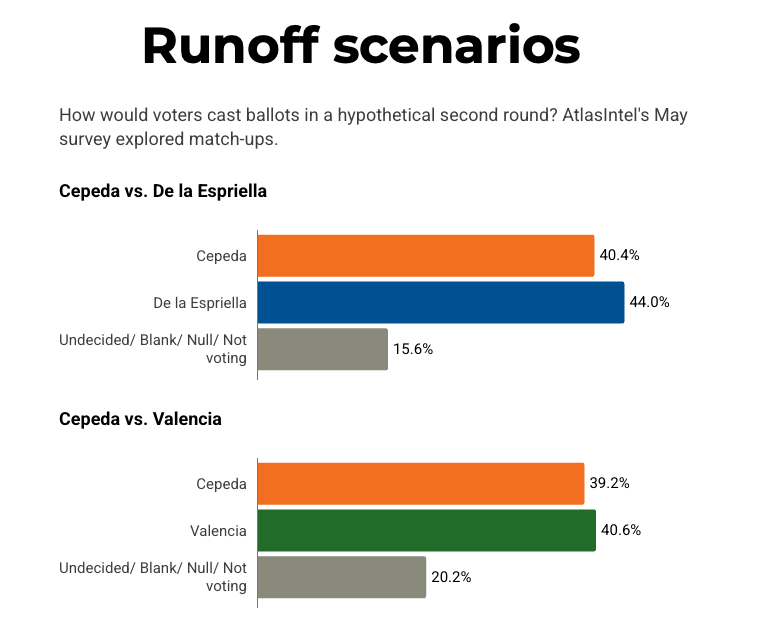
Recent polling suggests Cepeda holds a narrow lead ahead of Sunday’s vote, though few observers expect any candidate to win outright and avoid a June runoff. Valencia and de la Espriella have framed the election as a battle to restore investor confidence, revive Colombia’s pro-business tradition and reverse what they describe as institutional and economic decline under Petro’s administration.
Copper push
Mining executives and analysts say the outcome could shape the future of Colombia’s copper ambitions at a time when countries worldwide are racing to secure critical minerals needed for electrification and renewable energy infrastructure.
Colombia has launched tenders for 14 strategic copper regions and updated its list of priority minerals, but investors remain wary after reforms expanded environmental restrictions, increased taxes and created uncertainty over permitting and concession rules.
“From an investor standpoint, the key is not only who wins, but whether the next president can build a governing coalition that delivers regulatory stability,” said Juan Ignacio Guzman, head of mineral consulting firm GEM. “Copper is a multi-decade investment that is extremely sensitive to timeline uncertainty.”
The broader industry has struggled under mounting pressure. Mining contracted more than 6% last year as higher taxes, declining exploration and insecurity in mineral-rich regions weighed on activity. Coal exports dropped 20% in 2025, gold exports fell 18% and investor confidence weakened after the government proposed a new mining law that would create a state-owned mining company, EcoMinerales, and restrict large-scale mining in environmentally sensitive areas.
Some investment decisions in mining and energy remain frozen until after the election, according to business leaders, while S&P Global Ratings last month downgraded Colombia to BB-, the country’s lowest-ever credit rating, after Petro suspended fiscal rules limiting government debt growth.
Analysts say investors are increasingly focused on whether a new government would restore regulatory predictability and fiscal discipline. “From the market perspective, the two main concerns associated with Cepeda are lack of commitment with fiscal consolidation and central bank independence,” Alejandro Arreaza, an economist at Barclays, said in a note. Petro’s appointees to Colombia’s central bank have increasingly questioned the country’s 3% inflation target and opposed aggressive rate increases, raising fears among bondholders and investors about political pressure on monetary policy.
Gold and violence
The stakes extend far beyond politics. Colombia holds significant deposits of coal, gold, nickel and prospective copper resources along the Andean metallogenic belt, yet the country remains a marginal copper producer compared with Chile and Peru. AngloGold Ashanti’s (JSE: ANG; NYSE: AU; ASX: AGG) Quebradona project, Cordoba Minerals’ (TSX-V: CDB) Alacrán development and Copper Giant Resources’ (TSXV: CGNT) Mocoa project form part of a growing pipeline that could eventually transform Colombia into a meaningful supplier of critical minerals.
Companies including Glencore (LSE: GLEN), Rio Tinto (ASX, LSE: RIO) and AngloGold Ashanti have long viewed Colombia as a high-potential jurisdiction, though projects often face years of delays tied to permitting disputes, environmental opposition and regional insecurity.
Security has also emerged as a defining issue in both the election and the mining sector. Violence linked to illegal gold extraction and organized crime has spread across rural Colombia, particularly in regions where dissident guerrilla factions and narcotics traffickers control mining supply chains. Analysts say Petro’s “Total Peace” negotiations have failed to contain armed groups, allowing illegal mining networks to expand.
“The failure of President Gustavo Petro’s ‘Total Peace’ policy means that violence will continue to be a concern for the mining sector under any future administration,” Robert Munks, head of Americas at Verisk Maplecroft, said. “Illegal mining now accounts for roughly three-quarters of Colombia’s gold exports.”
Illegal mining has become one of the country’s most lucrative criminal businesses as soaring bullion prices fuel what analysts describe as a “narco-mining” economy. Across parts of the Amazon basin and Colombia’s Pacific regions, armed groups use illegal gold operations to finance weapons purchases, territorial expansion and recruitment, according to analysts and security researchers. Former FARC dissidents and criminal organizations have increasingly shifted into mining as a stable source of cash flow, particularly in remote regions where state control remains weak.
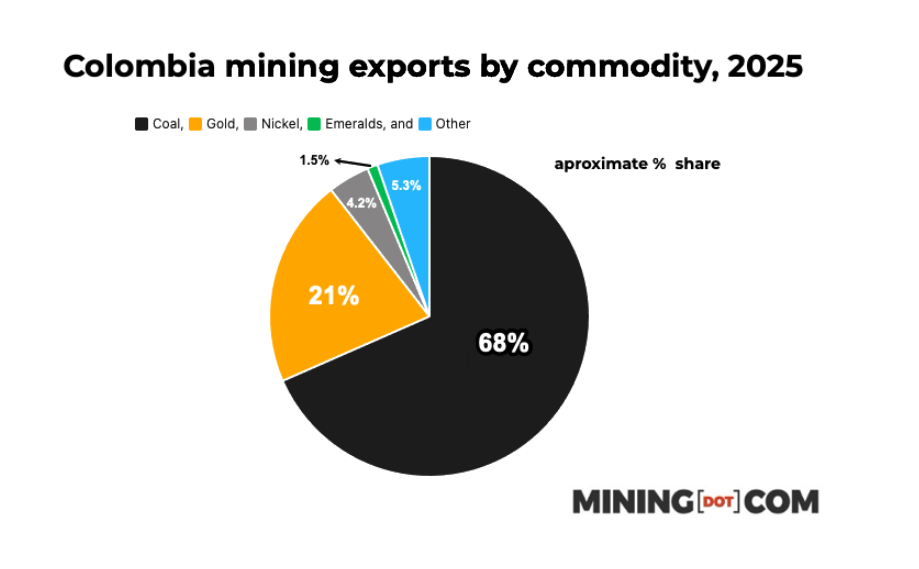
The illicit trade is also reshaping Colombia’s relationship with global markets. The country exported about $4.1 billion in gold in 2024, with roughly $1.5 billion shipped to the United States, according to UN trade data. Researchers warn that illegal production is becoming deeply embedded in international supply chains as criminal groups blend illicit gold with legal exports.
Investor gamble
For mining investors, the election may ultimately hinge less on ideology than predictability. The financial community and mining executives say billions in potential spending on copper, gold and energy projects remain sidelined until Colombia’s political direction becomes clearer.
Companies are closely watching whether the next government streamlines permitting, eases licensing bottlenecks and restores confidence in fiscal stability after years of policy volatility under Petro’s administration.
If the next administration can stabilize regulations, strengthen security and create clearer permitting timelines, analysts say Colombia could emerge as a strategic supplier of copper and other critical minerals as global demand accelerates. Failure to do so risks leaving one of the region’s richest untapped mining jurisdictions trapped in political and regulatory paralysis.




Be the first to comment on "Colombia election could reshape copper investment"