
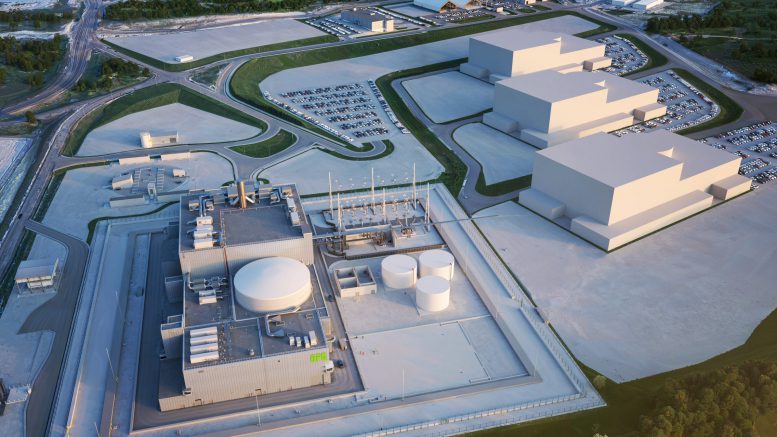
Ontario has started construction on the first small modular reactor (SMR) in the G7, as rising power demand and tightening fuel markets test whether new nuclear projects can be delivered at scale.
At the Darlington site east of Toronto, Ontario Power Generation (OPG) has begun building the first of four reactors, each designed to generate 300 megawatts (MW). The first unit, a GE Hitachi BWRX-300 reactor, is expected to come online by the end of the decade. Once completed, the full project is expected to deliver 1,200 MW of capacity, enough to power around 1.2 million homes.
“It strengthens Canada’s role as a trusted partner in a world increasingly focused on energy security and resilient supply chains,” Erveina Gosalci, founder and CEO of the Canadian Association of Small Modular Reactors and the SMR Forum, told The Northern Miner.
For some in the nuclear industry, the Darlington SMR is an opportunity to elevate Canada’s expertise to the world stage while also driving investment in the domestic supply chain, including demand for uranium and reactor construction materials such as zirconium, niobium and specialty steels.
Competition
However, Canada is entering an increasingly competitive field. The United States, the United Kingdom and France are all advancing their own SMR programs, with an emphasis on standardized designs and repeat builds that can anchor domestic supply chains and create export opportunities.
“The United States and the United Kingdom are moving in that direction, with frameworks designed to support faster, more standardized licensing and repeat deployment,” Gosalci said in an email from London, U.K. “The global competition is increasingly about scale and speed.”
The timing reflects a shift in Ontario’s power outlook. After years of relatively flat demand, consumption is rising again on the back of electrification, industrial growth and data centres. That has pushed nuclear back to the centre of the province’s long-term supply plan, following major refurbishment programs at existing stations. Darlington is the first new nuclear build in Ontario in decades, marking a shift from extending the fleet to expanding it.
The Darlington project has been structured as a long-term, strategic investment, with up to $2 billion from the Canada Growth Fund, $1 billion through the Building Ontario Fund, and a $970-million loan from the Canada Infrastructure Bank.
The key question is whether construction timelines, regulatory processes and industrial capacity can support a multi-unit build program rather than a single flagship project.
“This requires a shift from a project-by-project model to a design-and-program model,” Gosalci said. “In practical terms, that means clearer timelines, stronger pathways for standard design approval, more predictable permitting, and regulatory treatment that allows repeat projects to benefit from prior experience.”
New fuel
The introduction of the Darlington SMR into Canada’s nuclear ecosystem also signals a shift in fuel requirements. Most of Canada’s existing reactors run on natural uranium fuel, supplied largely by Cameco (TSX: CCO; NYSE: CCJ), one of the world’s largest uranium producers.
Ore mined in northern Saskatchewan is processed into uranium oxide (U3O8), known as yellowcake, and shipped to Cameco’s Port Hope facility in Ontario, where it is converted into uranium dioxide (UO2) powder and fabricated into fuel bundles for CANDU reactors.
Unlike most reactors globally, CANDU units do not require enrichment, allowing Canada to rely on a largely domestic fuel cycle with minimal exposure to the more constrained global conversion and enrichment markets.
The new Darlington SMRs require enriched uranium. “In Canada, we don’t enrich,” David Novog, director of the McMaster Institute for Energy Studies and an expert on nuclear reactors said. “So part of the decision to build those reactors is essentially becoming dependent on a foreign fuel source.”
Some of the uranium can be converted at Cameco’s Port Hope facility, but enrichment will still need to be done abroad by players such as Urenco in the U.S. or France’s Orano.
Novog said the shift ties Canada into a global enrichment supply chain that is still being rebuilt.
Energy security
As the U.S.’s war with Iran and Russia’s ongoing invasion of Ukraine continue to test energy security, SMRs are being promoted as strategic infrastructure.
Canada released a SMR action plan in 2020, which included building domestic capacity and exporting the technology, piggybacking on the success of CANDU exports. However, there haven’t been many public updates to the plan since 2022, aside from the federal government’s $2 billion investment package last year.
The SMR category is broad, and the success of specific reactors will depend on how far designs move beyond established operating experience, said Megan Moore, technical director with the advanced reactors division at Canadian Nuclear Laboratories (CNL), a federal research organization.
“Some SMR technologies are much closer to what we already know how to build and operate,” she said. “Others introduce new materials or operating conditions that require additional validation before you can really scale them up.”
The constraint emerges in proving performance over time, Moore said. “That’s what ultimately determines whether something is ready to scale, or still needs more validation.”
As far as SMRs go, the BWRX reactor being built at Darlington is considered mature technology. With current market demand, Moore said there’s potential for Ontario to move more quickly than it did with CANDU. The province powered up the first CANDU at Douglas Point near Kincardine, Ont., in 1968. By the 1990s, it had installed 18 CANDU reactors across the province.
“Canada’s a mature nuclear nation,” Moore said. “We’ve got a regulator that’s very experienced and operators like OPG that will be operating the Darlington SMRs that are experienced – now the second round is going to benefit from that.”
Be the first to comment on "Darlington SMR renews Canada’s nuclear maturity "