
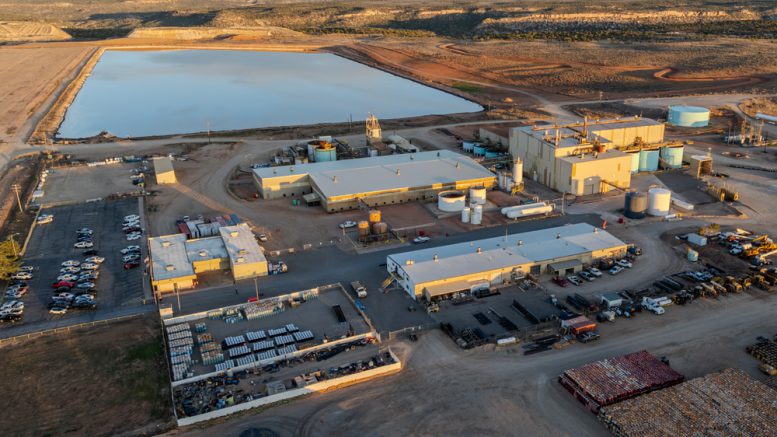
Energy Fuels (NYSE: UUUU; TSX: EFR) has produced its first kilogram of terbium oxide from the White Mesa mill in Utah, marking another step in its domestic heavy rare earths production capacity as it looks to expand commercial production as soon as 2027. Shares rose.
The pilot-scale output reached a purity of 99.9% terbium, meeting the specifications of permanent magnet manufacturers, Energy Fuels reported Wednesday. The milestone follows the company’s production of 29 kg of 99.9% pure dysprosium oxide in December, another heavy rare earth that co-occurs with terbium. Both metals are subject to Chinese export controls.
“This success proves we can process and produce high purity ‘heavy’ rare earth oxides economically and at scale in the U.S.,” Energy Fuels CEO Mark Chalmers said in a release. “North America will soon have a reliable and secure U.S. commercial source of these vital critical materials ensuring availability for high-performance magnet and defense technologies.”
Rare earths tailwinds
The terbium production adds to strong traction for Energy Fuels over the last few months, after its January announcement of a deal for rare earth metals producer Australian Strategic Materials (ASX: ASM). The acquisition would create the largest, fully-integrated rare earth elements producer outside China. In January, Energy Fuels also released a feasibility study showing the White Mesa mill could become one of the biggest producers of separated rare earths outside China.
The mill, about 500 km southeast of Salt Lake City, is the only operating conventional uranium facility in the U.S. and the country’s only plant capable of processing light and heavy rare earths. The 17 rare earth elements are key components in electronics and electric vehicle batteries.
Shares gained 8% to C$26.95 apiece on Wednesday morning in Toronto, valuing the company at C$6.5 billion. The stock has traded in a 12-month range of C$4.59 to C$38.37.
Energy Fuels also plans to expand its heavy rare earth element production capacity at White Mesa for commercial-scale recovery of dysprosium, terbium, samarium, europium and gadolinium. That expanded circuit could become operational as early as next year, at annual recoveries of up to 35 tonnes of dysprosium, 12 tonnes of terbium and potentially other heavy rare earths, and 850 to 1,000 tonnes of neodymium-praseodymium (NdPr).
The company’s terbium oxide and dysprosium oxide have been requested by several magnet manufacturers globally to start production validation, Energy Fuels said without specifying names. The terbium was sourced from monazite ore mined in the U.S.
Ucore building RE chain
Meanwhile, in another boost for domestic rare earth supply chains, Ucore Rare Metals (TSXV: UCU; US-OTC: UURAF) this week signed a non-binding deal with private magnet manufacturer Vulcan Elements to supply separated NdPr and dysprosium oxides.
Vulcan is building a 10,000-tonnes-per-year (tpa) neodymium-iron-boron magnet plant in Benson, N.C. backed by $1.4 billion in funding from the U.S. government and private sources. Once operational, the factory would be the largest magnet plant outside China.
“[The deal] provides Ucore with another potential customer for its separated total rare earth oxides output from Louisiana, with plans to finalize a longer-term supply arrangement should testing yield positive results,” Red Cloud Securities analyst Alina Islam said in a note on Wednesday.
A future binding agreement would help build a fully domestic rare earth magnet supply chain where Ucore separates the elements at its Alexandria, La. plant and Vulcan makes them into magnets, she added.
Ucore aims to produce its first high‑purity rare earth oxides this year and ramp up output to about 7,500 tpa in 2028. Ucore also operates a demonstration facility in Kingston, Ont.
White Mesa expansion
Energy Fuels is planning to further expand its NdPr, dysprosium and terbium production capacity to other rare earths through a Stage Two circuit expansion as soon as 2029, it said. The expansion would raise output to more than 6,000 tpa of NdPr oxide and about 80 tpa of terbium and 288 tpa of dysprosium.
Energy Fuels has applied to the state of Utah for permits, which it expects by mid-2027, when construction could begin, President Ross Bhappu told The Northern Miner at the PDAC conference in March. Bhappu is due to take over as CEO in April when Chalmers retires.
Be the first to comment on "Energy Fuels notches first terbium rare earths output"