

Gold recovered from a dramatic decline on Monday after U.S. President Donald Trump postponed military strikes against Iran, easing market worries of inflation caused by a prolonged war.
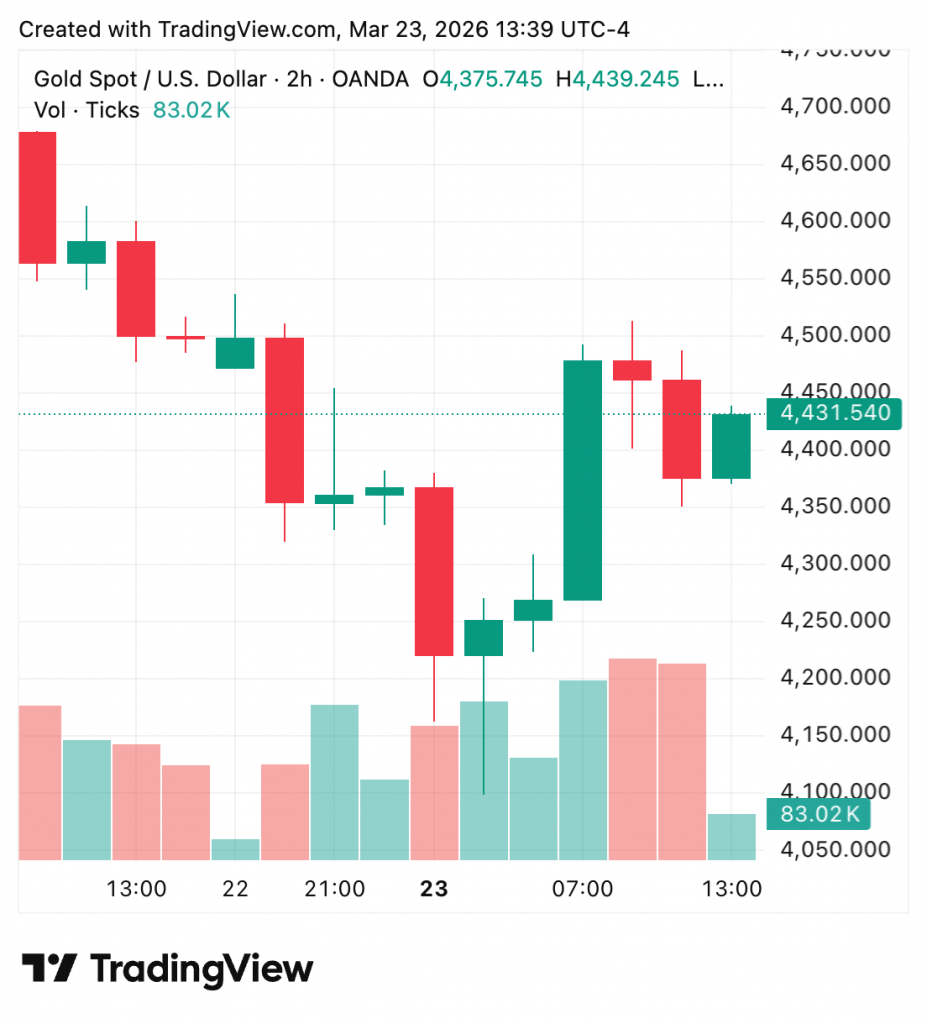
Earlier, spot gold had plunged as much as 8% in London to nearly $4,100 an oz. — the lowest seen in 2026. However, it began to rebound after Trump announced of a five-day pause on military strikes, citing what he called in “productive” conversations with Iran.
By 11:15 a.m. in New York, the metal had trimmed most of its losses, down 0.6% on the day at about $4,480 per ounce. Futures prices on the Comex were still 2.7% lower, trading at $4,471 an ounce. Silver also rallied back from more than 10% down.
Worst week since 1980s
The yellow metal is coming off its worst week since the 1980s amid a broader market rout.
Prior to Monday, bullion had fallen for eight straight sessions, as an escalating war in the Middle East triggered widespread fears about global inflation, which reduces the likelihood of interest rate cuts and erodes the value of assets like precious metals. A stronger U.S. dollar in recent weeks also added to the selling pressure.
As well, a global liquidity crunch has forced investors to sell profitable positions such as gold to cover losses elsewhere, in particular equities. Historically, the metal has served as a safe haven during times of uncertainty, but its pronounced rise over the past year meant that gold has become an “overcrowded trade”, according to analysts.
“Gold is right now trading like a risk asset, as it has during most broad risk-off moments over the past two decades,” Citigroup said in a note Monday. “This pro-cyclical risk asset behavior is particularly extreme given the large amount of momentum and retail buying of gold that we have seen over the past six months.”
Central bank sales
Analysts also pointed to the possibility that central banks have been selling gold, or at least slowing purchases of the metal, due to higher energy prices caused by the war.
“It is likely that some central banks are selling gold to defend their currency and/or to fund energy purchases,” and that this was behind gold’s precipitous drop early Monday said Bernard Dahdah, an analyst at Natixis.
The monetary institutions have been on a massive accumulation streak since 2022, though the pace of purchases had already started to slow going into this year.
Be the first to comment on "Gold price rebounds from 2026 low as Trump postpones attack on Iran"