
Ontario is pivoting from battery plant construction in its critical minerals strategy while it adds high-grade iron ore and aluminum to its list of important outputs.
The previous strategy focused on the electric vehicle market and emphasized the need for clean technologies, but the world has changed — fast and dramatically, Energy and Mines Minister Stephen Lecce said in prepared remarks on Tuesday in Toronto. Escalating geopolitical tensions, supply chain disruptions, U.S. tariffs and rising trade protectionism demand a sharper, more agile response, he said.
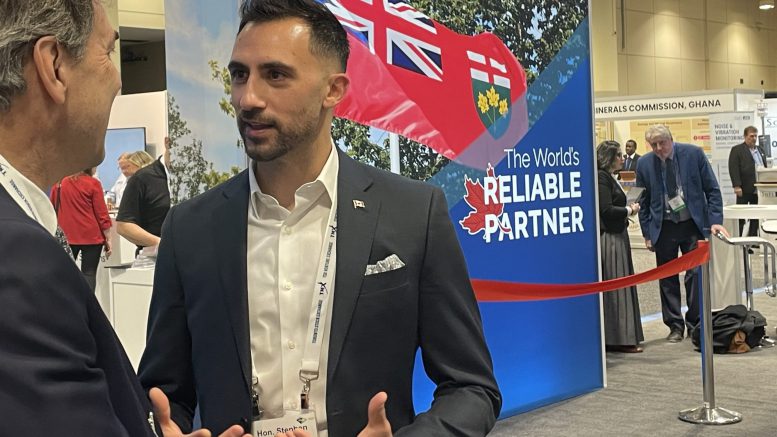
“Our strategy is about broadening our economic focus to include sectors like defence, aerospace that are in advanced manufacturing that are highly consequential to our province,” Lecce said in a reply to a reporter’s question on the shift. “We, of course, will continue to support the EV supply chain, start to finish. We have that advantage in the province.”
Honda’s roughly $15-billion EV and battery complex in Ontario has been postponed by about two years amid softer demand; the $5-billion Stellantis–LG Energy Solution NextStar plant in Windsor was briefly halted in 2023 before resuming and later restructuring; and Volkswagen’s PowerCo plant in St. Thomas, initially pegged at about $7 billion to $14 billion, remains on track for a 2027 start.
Defence angle
The province’s broadening focus includes defence applications as Toronto makes a bid to host an international defence bank, Lecce said. Ontario wants to incorporate the proposed NATO-backed financing institution in a broader push to anchor security-related investment, the minister said at the Prospectors and Developers Association of Canada convention in Toronto.
“There’s an increasing level of investment by NATO nations and a 5% investment we see trickle down benefit for our extractive sector,” he said. “And so we want to be proactive and intentional to secure those jobs and investments in the province.”
On the critical minerals strategy, new consultations are being scheduled with industries, First Nations and the public to update Ontario’s five-year document, first released in 2022. The new strategy is targeted for a 2027 release.
Automakers have pulled back on investment as EV sales growth cooled, contributing to delays such as Honda’s project and the restructuring of Stellantis’ Windsor battery plant. Policy competition between the United States and Canada has also reshaped the landscape, with the U.S. Inflation Reduction Act of 2022 prompting higher Canadian subsidies and contributing to disputes that temporarily halted construction in Windsor.
At the same time, companies are tightening capital allocation, reassessing multibillion-dollar battery projects and adjusting capacity or timelines to better align with demand.
Shifting plans
Ford Motor (NYSE: F) has scaled back its Ontario electric vehicle plans, abandoning a previously announced EV program at its Oakville assembly plant and shifting the facility towards production of gasoline-powered Super Duty trucks after investing more than $2 billion.
General Motors (NYSE: GM) has suspended production of its BrightDrop electric delivery vans at the CAMI plant in Ingersoll, Ont., despite a roughly $1-billion retooling, as the company reassesses demand and the facility’s future role.
The province also added high-purity iron ore and aluminum to its list of critical minerals, extending the number to 35. The first expansion since the list’s inception in 2022 underscores a commitment to bolstering end-to-end supply chains that support manufacturing amid ongoing U.S. tariffs, Lecce said.
Be the first to comment on "PDAC: Ontario shifts metals strategy to defence as EVs stall, mining minister says"