
🎥 Watch the video: [English] | [French]
🗞 Read the full article in French
On the rugged shores of Placentia Bay in southeastern Newfoundland lies a place shaped by sea spray, fog, and dreams bigger than its size. Long before roads or deep‑water ports, this was the tiny fishing settlement of Petit Plaisance — “Pleasant Little Place” — named by French mariners who came here in the 1600s to haul cod from the richest banks in the North Atlantic.
But by the late 19th century, something stirred beneath the surface — something that would change how the world knew this isolated corner of what is known as“The Rock.”
A Priest, a Prospect, and a Name Reborn
It was Father John St. John, the energetic parish priest of Holy Rosary Parish, from 1895-1911, who first gave voice to a new identity for this humble community. In the shadows of towering cliffs near Broad Cove Point, local prospectors had stumbled on glittering veins of galena — rich lead ore that carried silver deep in the rock.
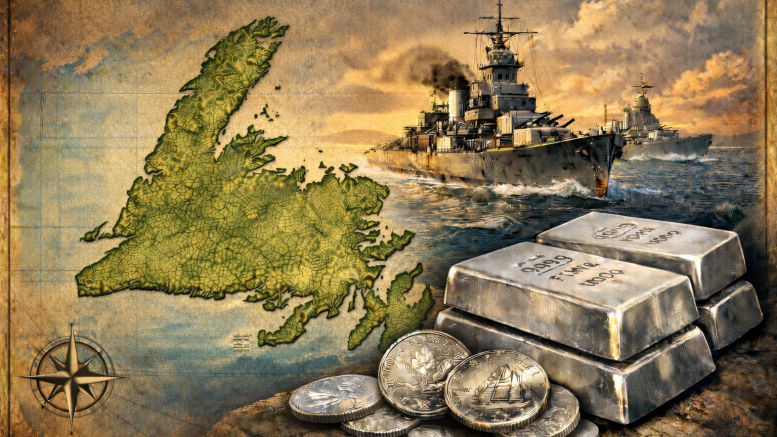
The word on everyone’s lips was “argent,” the French word for silver often heard in taverns. Around 1900, at Father St. John’s urging, Little Placentia was renamed Argentia — the ‘Silver Valley’ to the locals.
The discovery brought excitement — and high hopes — to this coastal outpost. Men like John Burke, the prospector credited with locating the first silver exposed in veins in the early 1880s, sold claims to English investors who dreamed of striking it rich.
But the silver remained stubborn, locked in narrow quartz veins that teased more than they delivered. Over decades, the silver found at the Cliff Mine opened and closed, worked in “fits and starts” as financiers came and went, metal prices swung, and winter storms battered the shore. Miners carved short adits into rocky slopes and hauled ore down narrow trails, but the bounty that had lifted hopes never quite paid its way.
Storm Clouds Over the Argent Cliff
By the early 1920s, the mine had shut down for good. Argentia’s dream of silver always seemed out of reach — yet the echoes of pickaxes and ore cars clung stubbornly to the hillsides. Townsfolk returned to fishing and the rhythms of daily life, but many still whispered about what might have been.
Then, in the shadows of Europe’s rising turmoil, a new force arrived on Argentia’s doorstep.
World War II: From Quiet Harbour to Global Stage
In 1940, as war engulfed Europe and the Battle of the Atlantic raged unseen beneath the waves, leaders in Britain and the United States made a daring decision. Under the “Destroyers for Bases” agreement,” the tiny harbour at Argentia was chosen for a major new U.S. naval and air base — a strategic foothold to guard the convoys crossing the North Atlantic.
The change was immediate and dramatic. Families who had lived in Argentia for generations were asked — and sometimes forced — to leave their homes so runways and barracks could be built. By early 1942, almost every resident had moved to nearby communities like Freshwater and Placentia.
The construction that followed was nothing short of feverish: thousands of Newfoundlanders laboured side by side with American engineers, and by 1943 more than 12,000 U.S. servicemen were stationed here, transforming the once‑tiny harbour into one of the largest foreign naval bases in existence.
Then, in the fog and salt spray off Placentia Bay in August 1941, two of the world’s most powerful leaders — U.S. President Franklin D. Roosevelt and British Prime Minister Winston Churchill — met aboard warships anchored just offshore. There, far from London or Washington, they forged the first outline of the Atlantic Charter, a bold blueprint for a peaceful world after the war.
From Silver Undercurrents to Maritime Dreams
Long after the last soldiers left and the base was finally closed in 1994, Argentia’s story didn’t end — it changed direction. What was once a quiet fishing village, then a hopeful mining hub, then a strategic wartime base, has become something new again: a deep‑water port and industrial centre, connecting continents and continents’ cargo in the same bay where silver lay waiting more than a century earlier.
Today, the ghosts of silver that fueled the mines may linger in collapsed adits and scattered relics — reminders of a dream that never quite paid off — but the heartbeat of Argentia is found on the docks and tarmac where ships and wind‑energy components now arrive from around the world, anchoring this Atlantic outpost in the global economy once more.
Be the first to comment on "The Northern Miner Treasure Hunt: Argentia: The Land of Silver — and Second Chances"