
A strong showing by pro-business candidates in Chilean elections yesterday bodes well for the resurgence of mining investment in the world’s largest copper producer.
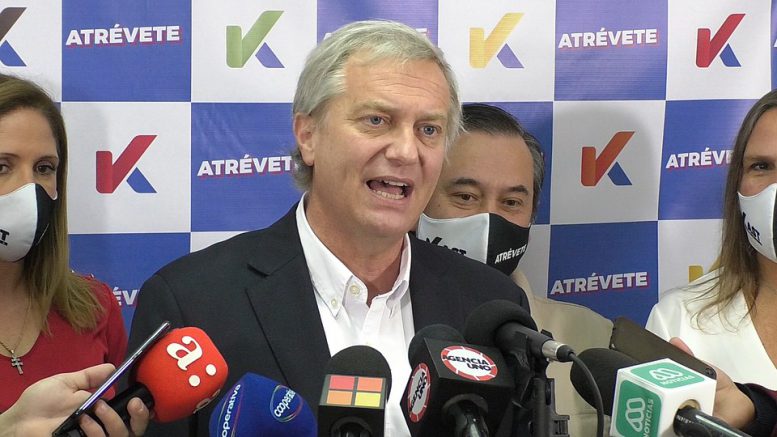
Although conservative hardliner José Antonio Kast took 23.9% of the vote, almost three percentage points behind Communist former labour minister Jeannette Jara, he is expected to win a Dec. 14 runoff by a landslide, picking up votes from rival candidates, according to the latest polls.
“If you just add up the votes for the right, Kast has a very significant base of support for the second round,” said Hernán Campos, a political scientist at the Diego Portales University in Santiago.
Kast has campaigned on attracting more investment by slashing corporate tax rates, regulation and public spending, while reintroducing guarantees for foreign investors to shield them from future tax and regulatory changes. He has promised an emergency administration to deploy troops against rising crime and illegal immigration, which voters say are their most important issues.
Right-wing parties, including Kast’s Republicanos, also performed well in elections to Congress which would make it easier for Kast to push through his reform program.
Mandatory vote
The ballot is notable as the first where voting is compulsory. It comes after six years of political uncertainty as majors BHP (NYSE, LSE, ASX: BHP), Freeport McMoRan (NYSE: FCX) and Teck Resources (TSX: TECK.A,TSX: TECK.B; NYSE: TECK) plan to invest billions of dollars. Copper and gold prices are near record levels and demand for lithium is expected to surge.
“Today we’re a land of opportunities in mining,” said Mirco Hilgers, a mining partner at Baker McKenzie’s law offices in Santiago.
Kast’s challenge is now to unite enough votes from rival campaigns to win next month’s runoff. Centre-right veteran Evelyn Matthei and nationalist libertarian Johannes Kaiser quickly endorsed him. Each received around 13% of the votes counted, putting Kast very close to the 50% mark. But the main prize will be the backing of Franco Parisi, a maverick populist who surprised pollsters to finish third with almost 20% of the vote.
“These [voters] are people who are not ideologically defined but are concerned about law and order and the economy, and Kast resonates best with these demands,” Campos noted.
On the campaign trail, Kast has downplayed his conservative views on social values issues like abortion and same-sex marriage which turned off some voters four years ago in a runoff against Boric.
Jara
Polls suggest that Jara, current president Gabriel Boric’s successor on the ballot since winning the left’s primary last June, is likely to struggle in the second round. Campaigning on raising the minimum wage and stronger labour laws, she has been unable to distance herself from the current government and attract votes beyond its core supporters.
“Jara failed to get 30% as many expected and she was the only significant leftwinger running so she has not got much room to grow in December,” Campos said.
Boric, who cannot seek immediate re-election, won a surprise landslide four years ago. As Chile’s most leftwing leader in half a century, the former student organizer had promised to tear up the constitution, dismantle the private pension system, ramp up taxes on mining and the very rich and “bury neoliberalism.”
However, his ambitious plans have been stymied by a lack of congressional support and changing public sentiment.
Less than a year later, voters overwhelmingly rejected a constitution which would have weakened property rights and beefed up environmental protection. Lawmakers blocked a major tax hike while a punitive mining royalty was significantly watered down.
As voters’ concern turned to more bread-and-butter issues such as crime, jobs and the cost of living, Boric’s administration has strived to prove its credentials with investors. It slashed red tape in Chile’s labyrinthine permitting system and signed new trade deals with the European Union, United Arab Emirates and the Trans-Pacific Partnership.
“We’re finally sobering up after the party,” said Maria Paz Pulgar, mining partner at Santiago law firm Guerrero, of Chile’s volte-face.
Investment
The completion of major projects such as Teck’s Quebrada Blanca and Gold Fields’ (NYSE, JSX: GFI) Salares Norte and the approval of a $3-billion expansion of Anglo American’s (LSE: AAL) Los Bronces mine showed that, despite recent instability, Chile is a destination where mining is still welcome.
“The current government has really changed the rhetoric around permitting,” said Hayden Locke, CEO of Marimaca Copper (TSX: MARI, ASX: MC2), which obtained an environmental license this month for its namesake $587-million capex project.
As conditions have stabilized, investment has poured in. BHP plans to invest up to $14 billion to bolster production at Escondida, the world’s biggest copper mine, and reopen its shuttered Cerro Colorado mine while Freeport McMoRan is eyeing an $8-billion expansion of its El Abra joint venture with state copper firm Codelco.
“Now they’ve run out of money, they realize the importance of mining,” said Manuel Viera, president of Chile’s Chamber of Mines.
Even Boric’s National Lithium Strategy, once feared as a veiled nationalization, has proved a boon. State partnerships with Rio Tinto (NYSE, LSE, ASX: RIO) and SQM (NYSE: SQM) are set to unlock investments which could double production of the mineral within a decade. Although questioned during the election campaign, China’s recent approval of the Codelco-SQM tie-up means that “it is a done deal,” Pulgar said.
Projects
A Kast win Dec. 14 should be good news for a slew of new mining projects advancing towards construction.
After obtaining an environmental license in November, Marimaca Copper is aiming to start construction of its project in northern Chile by the end of next year. The solvent extraction-electrowinning operation could be producing 50,000 tonnes of copper cathode annually by the end of the decade.
Shareholders, including Greenstone Resources, Assore and Mitsubishi, are raring to go. “It’s very rare in my career, but financing is not my biggest concern,” Marimaca’s Locke said.
Hot Chili (ASX: HCH) is another company aiming to reach production by 2030. Exploiting three deposits in the Atacama Desert, its Costa Fuego would produce 100,000 tonnes of copper mostly as concentrate for export.
“We see the new government providing a tailwind for the mining industry,” Hot Chili Executive Vice-President Jose Ignacio Silva said.
Claims fees
Another reform promises to boost mineral exploration which has waned over the last decade. In 2021, to finance a new universal pension, Boric’s predecessor boosted claims fees.
The move has shaken up Chile’s sleepy market in mining property under which mining companies and individuals could sit on huge areas for decades for minimal fees and no work requirements. Firms like BHP, Codelco and SQM managed portfolios the size of small countries, cutting off much of Chile from newcomers keen to explore.
With fees now set to quadruple every four years unless companies can show efforts to develop the claim, many landholders are selling off giant packages of the Atacama Desert and the Andes Mountains, sparking an unprecedented fire sale in mineral property.
“I’ve been in this industry 20 years and never seen anything like it,” Baker McKenzie’s Hilgers said. “Chile’s becoming attractive again for mineral exploration.”
Not everyone is pleased. Small mining companies say the exponential rise in fees amounts to expropriation of assets which are key to their future development. Some have taken legal action to block the move, Marco Zavala of law firm Guerrero said.
The issue could become a major test of the new president’s willingness to stand up to vested interests in order to realize Chile’s mineral potential.
Be the first to comment on "Chile vote thrusts right-winger to runoff "