
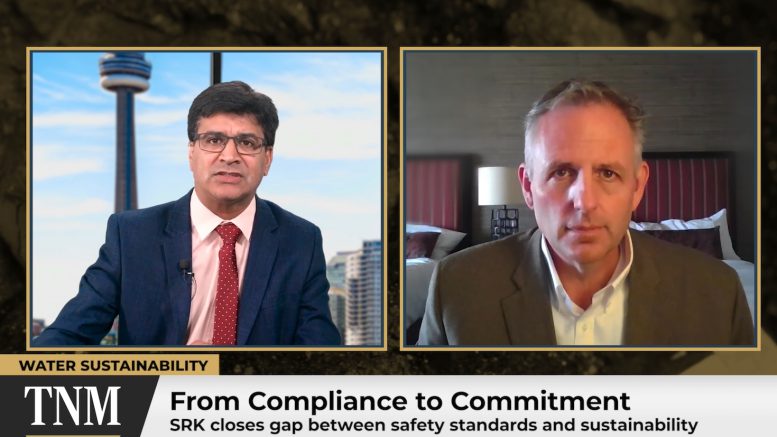
How mining manages its waste will shape how the world judges its future. Tailings and water management aren’t just technical hurdles – they’re social, environmental and financial tests that define a project’s legacy.
From ensuring safe storage to protecting scarce water resources, tailings management is no longer optional – it’s the measure of responsible mining.
The Northern Miner’s Devan Murugan caught up with Terry Braun, president of SRK North America and newly appointed director of SRK’s tailings centre, to explore how the industry can turn these pressures into practical solutions.
Devan Murugan: Terry, thanks very much for speaking with us.
Terry Braun: Devan, it’s a pleasure to be here.
DM: When we talk about sustainability in tailings and water, what’s really at stake for miners today? Why has water become such a defining issue?
TB: Water is essential to communities. We rely on it for drinking and irrigating crops and it also has spiritual significance for many people. Ecosystems depend on the abundance and availability of water and we know there are natural cycles of surplus and scarcity.
Minerals are where we find them, so when we see a responsible opportunity to develop an orebody, one of the first questions in any technical and economic assessment is: is there water available and is it reliable?
A typical mine moves water – dewatering open pits and underground workings, using water in processing at specific volumes per unit of ore and sometimes conveying materials as slurries. Wherever we use water that way, we get entrainment – a loss of water – and new surface water features can increase evaporation that wouldn’t otherwise occur. These impacts are real and known. The conversation is how to balance what communities and ecosystems need to thrive with what mining can reasonably mitigate. That’s at the forefront for our industry.
DM: You’ve said there’s still no fully consistent framework for disclosing how mines manage water. In simple terms, what does water stewardship mean on the ground and what standards or governance could make decisions more transparent and defensible?
TB: If we go back about 20 years – around 2005–07 – we started to see movement toward water stewardship as a goal and as a basis for disclosure and transparency, so we could understand trade-offs when developing water resources. It wasn’t unique to mining. The United Nations launched the CEO Water Mandate and Australia introduced water accounting frameworks – the first structured approaches for water balance accounting to communicate inputs, use and discharge.
About 10 years ago the Global Reporting Initiative, initially tied to climate disclosure, broadened its stakeholder consultations around water inputs and outputs. In the last decade we’ve also seen sustainability accounting standards emerge, so we now have company reporting and disclosures through international bodies. More recently, there’s been a push to reconcile and cross-reference frameworks to improve clarity and balance.
We’re converging in methodology, but not all companies follow the same frameworks and not all choose to disclose. Specialists also see a gap in the level of disclosure: regional or national roll-ups are useful, but real transparency often needs site-level reporting at the point of use. We’ve come a long way and there’s still room to improve.
DM: We’ve seen projects stall when communities fear for water security – Ecuador offers examples. How should mines engage early and co-design solutions to build trust?
TB: It starts with recognizing water availability as a strategic issue. Because mining brings a defined water demand and some level of disturbance or reallocation, companies need an evidence-based early appraisal of the basin: not just what it can physically yield, but the significance and reliability of the resource – including its cultural or spiritual value – and the ecosystem’s needs.
Direct measurement is where we often see the biggest gap. We can monitor groundwater levels, streamflow and water quality, but it takes time to understand natural variability – periods of abundance and absence – so models carry uncertainty even with good evidence. That means engaging communities early, assessing with the right stakeholders at the table – users, local communities, regulators – and doing the right thing scientifically for the ecosystem.
Increasingly, engagement with Indigenous and First Nations communities, who have long relationships with land and water, is starting earlier in the mining process. That dialogue will determine whether a project advances with a workable balance of communication, impact and offsets.
DM: Tailings are such a significant part of mining, yet many sites inherit old habits. Where do you see the biggest legacy risks and how should companies factor future liabilities into decisions today?
TB: Staying with water: I’ve been involved with a U.S. mine in the northwest corner of New Mexico, operated over decades and later as an open pit with sulphide exposure. The project is now closed, but the legacy pit lake requires long-term water treatment. In present-value terms it’s close to US$1 billion (C$1.4 billion) – not every company can absorb that. Had the owner understood that obligation upfront, it might have changed where waste was placed, whether to relocate it, or even whether to generate certain waste streams.
Another case is a proposed mine in northern Minnesota. The concept initially had good community engagement and sound science, but sensitivity to watershed disturbance – and potential effects on adjacent areas – led the board to reduce the project footprint. That lowered reserves and had a clear economic impact. Those two cases illustrate the trade-offs: inheriting a commitment versus avoiding it through design choices.
DM: What does the Global Industry Standard on Tailings Management change in practice? Who’s involved and how do you keep engagement going through closure?
TB: The standard was a wake-up call. As mines get larger or move into more challenging settings, tailings systems grow in complexity, with credible failure modes that can shift with subtle changes. The response has been to rethink how we build and integrate a knowledge base, and to bring all stakeholders into the room.
Free, prior and informed consent has been re-centred. We’ve formalized independent technical and geotechnical review boards to challenge design assumptions, created new monitoring streams to detect potential risk indicators and linked this to regular reporting to communities. The aim is to be transparent about choices to protect people and the environment, from construction through closure and beyond.
DM: As technology and climate pressures reshape mining, what gives you optimism that the industry can close the gap between compliance and true sustainability?
TB: It takes global experience and an integrated knowledge base. Firms like SRK, industry groups and academic consortiums – the tailings centre among them – are creating forums where practitioners advance how tailings are managed.
Concepts like integrated landforms and commingling waste rock and tailings can improve performance. Industry is pushing to reduce water footprints, adopt technologies that cut operational water needs and leave facilities that are chemically and physically stable for the long term – with community engagement throughout.
These forums are growing and attention is global. I recently spent a day with the Sustainable Minerals Institute at the University of Queensland, discussing the same technical and social transition issues – how to bring a project online with the right plans, operate responsibly and transition to a post-mining state. It’s encouraging to see the right people focused on these ideas.
DM: We’ll keep our eye on it. Terry Braun, president of SRK North America, thanks for your time.
TB: The pleasure’s mine, Devan. Thank you.
Watch the full interview below:
The preceding joint venture is PROMOTED CONTENT sponsored by SRK and produced in co-operation with The Northern Miner. Visit. www.srk.com for more information.




Be the first to comment on "Q&A with SRK: Turning pressure into practical solutions"