
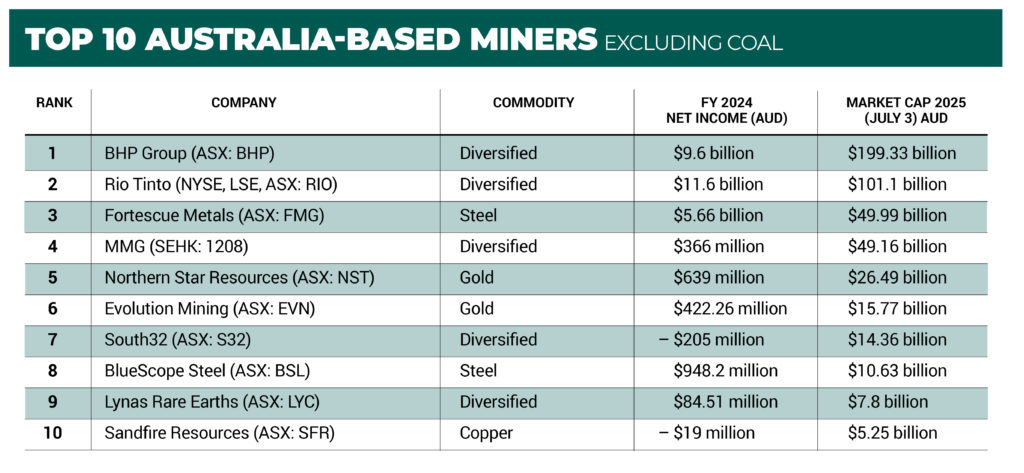
In The Northern Miner’s annual look at the world’s largest miners, Australia always figures prominently. This is third in a series after Canada and the United States.
The southern continent’s mining leaders by market value and net income, BHP (NYSE, LSE, ASX: BHP) and Rio Tinto (NYSE, LSE, ASX: RIO), are doubling down on future-facing minerals while iron ore stalwart Fortescue Metals (ASX: FMG) pivots towards green energy and gold producer Evolution Mining (ASX: EVN; US-OTC: CAHPH) rides high on record output.
BHP, the world’s largest miner, achieved new production highs in copper (2 million tonnes) and iron ore (290 million tonnes) for fiscal 2025. But it also reported in July that costs soared by $1.7 billion (C$2.33 billion) at the Jansen stage one potash project in Saskatchewan to as much as $7.4 billion. The company delayed first production by six months to mid-2027. Stage two expansion brings the total investment to around $12.3 billion.
The company blamed the cost increase on inflation, design changes and construction setbacks. “We are considering a two-year extension for the execution of Jansen stage two from fiscal 2029 to fiscal 2031,” BHP said July 18.
Jansen’s higher costs mark a major setback for BHP’s push to accelerate into the fertilizer sector after Russia’s invasion of Ukraine. In other forward-looking areas, the miner is partnering with China’s Baowu Steel on low-carbon steel- making and buying ammonia-fuelled ships to cut greenhouse gas emissions.
New CEO
Rio Tinto’s board chose iron ore unit chief Simon Trott in July as CEO to replace Jakob Stausholm, who unexpectedly resigned in May. Trott’s tasks include steering Oyu Tolgoi in Mongolia, the main engine of the company’s plan to increase copper output to roughly 800,000 tonnes of copper in 2025, an increase of about 200,000 tonnes.
He’ll also be trying to control Rio’s costs, which surged 47% from 2020 to 2024, as it pays more than half of the Simandou iron ore project’s $11.6-billion capital cost in Guinea. First ore there is due in November.
BMO Capital Markets mining analyst Alexander Pearce said Rio’s second quarter operational update in July was “a touch better than expected overall.”
Hong Kong-listed MMG stands out among Australia-linked miners for its expanded global portfolio, with major operations in Peru, Democratic Republic of Congo and Botswana. However, the recent June–July protests in Peru, sparked by informal miners blocking key roads, underscore tension at its Las Bambas mine. It accounts for about 80% of company output, hit- ting nearly 323,000 tonnes of cop- per last year.
A truce in protests has eased immediate pressure, but MMG warns that prolonged disruption could impact production. The company is responding not just with operational contingency but also with investment in social programs such as increasing diversity in hiring.
China demand
Fortescue has been a cash machine in the iron ore boom, posting a net profit of $5.7 billion in fiscal 2024 (up 18% from 2023) thanks to steady Chinese demand for its Pilbara iron ore. The company shipped a record volume last year, including first output from its new Iron Bridge magnetite mine. However it has suffered delays at its $3.9-billion Iron Bridge project citing technical challenges and design revisions.
Founder Andrew Forrest is transforming the miner into a powerhouse of green hydrogen, green iron and renewable power. Its new subsidiary, Fortescue Future Industries spent more than US$1.2 billion on clean energy projects in fiscal 2024.
Evolution Mining beat output and cost forecasts in its fourth-quarter update issued in July. Quarterly production of 182,000 oz. gold was slightly above BMO Capital Markets’ estimate of 177,000 oz. gold, but in line with a consensus of analysts. A mill expansion at Mungari helped lower all-in sustaining costs to A$1,562 (US$1,020) per ounce.
Northern Star Resources (ASX: NST) produced 1.63 million oz. of gold in fiscal 2025, with the Kalgoorlie Consolidated Gold Mines operation—home to the Super Pit—contributing more than half that total. The company is advancing a major mill expansion there to double throughput to 27 million tonnes per year, aiming to lift annual output to about 900,000 oz. by 2029. Commissioning is targeted for early fiscal 2027.
It’s also completing its A$5-billion all-share takeover of De Grey Mining.
Mid-tier miners
Australia’s mid-tiers are likewise adapting their portfolios for the new climate. South32 (ASX: S32), spent the last few years shifting from coal to electrification metals. It’s hitting annual guidance of 3.75 million tonnes of alumina output and copper-equivalent production from its Sierra Gorda joint venture in Chile, up 20% to 66,000 tonnes by April. It holds 45% of Sierra Gorda while Polish KGHM Polska Miedz has 55%.
But South32 may be forced to halt production at its Mozal aluminum smelter in Mozambique if it can’t secure a new power deal by next March. Last month it agreed to sell its Cerro Matoso ferronickel mine in Colombia in a deal worth up to $100 million.
Shares in Lynas Rare Earths (ASX: LYC), the largest rare earth producer outside China, gained 11% in July as momentum picked up in the sector supplying metals for defence, phones and electric vehicles amid concerns over China’s export controls.
Backed by Australian mining magnate Gina Rinehart, Lynas became the world’s first producer of heavy rare earths outside China this year. In June, Lynas signed an initial deal to get more feedstock for its plant in Malaysia.
Be the first to comment on "Top 10: Down Under giants adapt to global shifts"