
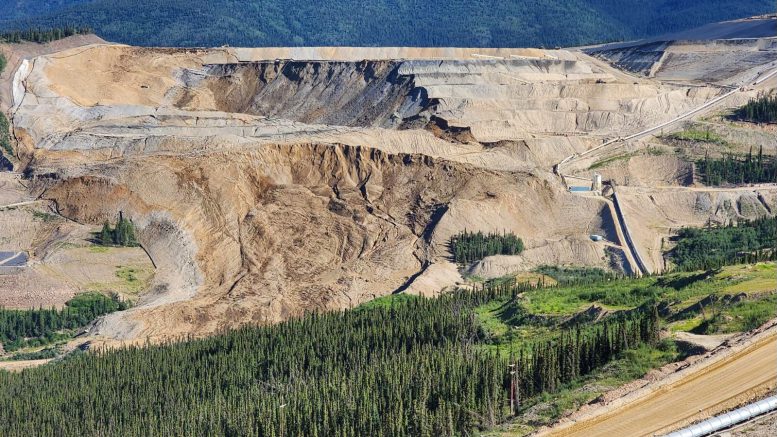
A Yukon Independent Review Board report blames the heap-leach failure at Victoria Gold’s Eagle mine last June on poor drainage that trapped water above a weak layer in the leach pad, which raised pressure and weight and caused the collapse.
Heap leaching is the process of stacking crushed rock on a pad which is then irrigated with a cyanide-containing solution that percolates down and separates gold from the ore. The board discovered that stacking frozen and fine-grained ore in the 975-lift, or a layer of ore at an elevation of 975 metres, raised pressures inside the solution-saturated ore. This increase caused a failure, resulting in 5.95 million cubic metres of ore sliding down the south slope in a rapid flowing slurry.
“From the outset, we have said that we needed this report before making any decisions about a potential public inquiry,” Yukon Mines Minister John Streicker said in a statement “Now that we have the information, we will review it thoroughly and determine the appropriate next steps…We will have more to say soon on how these findings may help to shape the future of mining in the Yukon, but our intent is clear: we can all learn from this incident and must continue working to ensure responsible, sustainable mining for the benefit of all Yukoners.”
The report by the board, formed of three members and three technical advisers, and released on Wednesday, comes just over one year after the Eagle mine in Yukon suffered a catastrophic landslide, which led to the company being put into receivership under PricewaterhouseCoopers last August. PwC is now looking to sell the mine as the cleanup effort proceeds.
Too much liquid
Improper drainage in the lift, along with issues collecting the gold-containing solution at the heap’s base, allowed a liquid-saturated zone to form during spring irrigation and snowmelt.
The board’s fieldwork and drone photo reviews confirmed visible ponding and seepage on the 975-lift before June 24 last year. Laboratory tests revealed the ore was too fine and dense for water to quickly percolate through.
Poor underdrain performance, increased irrigation with solution to areas on the pad’s south slope in April 2024 and overly steep ledges on the pad weakened the slopes’ resistance to slides.
Water monitoring
In the collapse, ore and cyanide solution was carried some 1,000 metres down Dublin Gulch Valley and into Haggart Creek, going as far as its confluence with the South McQuesten River, 27 km downstream.
Water monitoring by Yukon government scientists reveals that cyanide, mercury and ammonia were under aquatic life guideline levels, as of the latest data from mid-June, but levels for cobalt, copper and nitrates were above those levels, though on a downward trajectory.
Moving forward
The board’s recommendations touched on several areas. For the design and functioning of heap leach pads, it recommended improving how water moves through the heap to prevent buildup that weakens stability, more careful assessment of material properties and placement so that layers don’t trap water and more strictly controlled irrigation.
Heap slopes, stacking methods and safety margins should be reviewed to reduce risks and more monitoring measures should be introduced to detect warning signs of pressure and movement earlier on.
Operational controls and oversight around irrigation practices and slope management should be stronger. And regulators should build stronger technical expertise to effectively oversee complex operations and prevent future failures.
Streicker pointed out that the report was produced independently. It was funded by the court-supervised receivership.
Be the first to comment on "Board cites poor drainage for Eagle gold leach failure"