
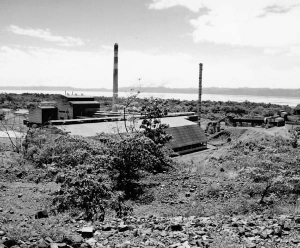
HudBayMinerals (HBM-T, HBMFF-O) and aspiring nickel producer Skye Resources (SKR-T, SKRZF-O) are combining forces, expanding Hud- Bay’s zinc and copper portfolio into nickel. Skye’s flagship asset is its past-producing Fenix nickel laterite project, in eastern Guatemala.
Under the proposed transaction, one Skye share will be exchanged for 0.61 of a HudBay share. The deal represents a 35% premium over Skye’s 20-day volume-weighted average trading price and a 17% premium over Skye’s closing price on June 20.
Following the merger, HudBay will have about 160.9 million shares outstanding, of which current Hud- Bay shareholders will hold 79.9% and former Skye shareholders will own 20.3%.
As part of the transaction, Hud- Bay will acquire 12.6 million shares of Skye at a price of $7.51 per share in a private placement for gross proceeds to Skye of $95.2 million.
The proceeds will be used to ramp up engineering, procurement and construction activities at Fenix, including the purchase of long lead-time equipment that had been suspended earlier this year due to the lingering effects of the credit crunch.
Vale (RIO-N) subsidiary Vale Inco has the right to participate in the financing to maintain its current 11% equity interest in Skye, but has chosen not to do so.
The news sent shares of Skye on the Toronto Stock Exchange soaring 97 apiece to close at $8.69, an increase of 12.5%, on a trading volume of 3.4 million shares. HudBay shares fell 78 to $14.01 per share on a trading volume of 7.1 million.
HudBay has a 52-week trading range of $13.70-29.63 with 126.4 million shares outstanding.
Skye Resources has a 52-week trading range of $3.85-17.20 with 51 million shares outstanding.
Skye’s Fenix project, in the Lake Izabal region of Guatemala, is expected to move into production in the last quarter of 2010 with full production likely in year three, and has an estimated mine life of 30 years.
The project has a proven and probable reserve of 41.4 million tonnes grading 1.63% nickel, plus additional saprolite and limonite resources in various categories.
Fenix will producehigh-grade ferronickel shot that will be exported to Asian, European and North American markets. The project’s capacity is the equivalent of about 60,000 tonnes of ferronickel containing 35% nickel per year. Ferronickel is used by steel companies around the world in the production of stainless steel.
According to a technical report on the project released in September 2007, production over the life of the mine is estimated to total 1.3 billion lbs. nickel. The average production for the first 20 years after ramp up (starting in year three) is 48.5 million lbs. per year of nickel contained in ferro-nickel.
Dundee Securities analyst Mike Collison is positive on what the move will mean for HudBay.
“I like the idea they’re going into nickel; I like the idea that they’re going into nickel in a development project; and I like the idea that they’re going into a nickel development project that has been shopped around and found unattractive by the deep-pocketed majors because theydon’t want to pay Vale the three per cent merchandising fee for the final product,” Collison says. “It (also) puts the company’s cash balance to work, diversifies the zinc price exposure, and the Fenix deposit has upside potential with expansions down the road.”
Collison has raised his rating on HudBay from neutral to a buy and has a 52-week target price on the stock of $21 per share.
Skye acquired 70% of Fenix from Inco in 2004. Since then, the Vancouver- based junior has increased its project interest through development spending and diluted its partner, the Guatemalan government. Skye’s subsidiaries currently own 98.2% of the project with the government of Guatemala holding the remaining 1.8%.
Inco operated the Fenix project (then known as Exmibal) in the late 1970s. Inco developed the deposit, and produced about 12,500 tonnes of nickel in matte per year from 1977 to 1980. But the smelter was closed in 1980 due to high oil prices and a weak nickel market.
The project has a US$238-million pyrometallurgical nickel processing plant and related facilities, which have been on care and maintenance for the last 28 years.
The existing facilities, however, will have to refurbished and expanded. Not all of Exmibal’s assets will be suitable or available for modification as the existing metallurgical plant produced nickel matte using conventional smelting technology, whereas the Fenix project will produce ferro nickel.
HudBay will have to build a power plant as the processing plant had previously been run on bunker oil. When the new 150-megawatt power plant is operating, nearly all fuel requirements will be supplied by coal and petroleum coke — essentially eliminating the operation’s prior sensitivity to the oil price. Petroleum coke is a byproduct of oil refining and will be sourced in bulk at oil refineries in the U. S. Gulf or in Aruba and Venezuela.
In a conference call, HudBay’s president and chief executive, Allen Palmiere, said the company sees the potential to build the power plant earlier, only 2.5 years after the processing plant starts operating, rather than five or six years after startup.
Once the power plant, which will cost roughly US$343 million, is up and running, Fenix should move into the lowest quartile in cash production costs among all planned and existing producers, Skye asserts.
In the September 2007 technical report, cash operating costs during the first five years of the project are estimated at about US$3.47 per lb. nickel. After the power plant is completed, cash operating costs are expected to decline to about US$2.34 per lb. nickel. The operating costs were calculated using estimates of long-term pet-coke, coal and oil prices.
Based on a nickel price of US$6.50 per lb., an iron credit of US20 per lb. nickel, and royalties and other costs of US49 per lb., the project’s internal rate of return has been estimated at 14.3% and its net present value forecast at US$490.6 million with an 8% discount rate.
At a US$6.50-per-lb. nickel price, the payback period is forecast at about 7.3 years.
Fenix hosts significant limonite mineral resources, which cannot be treated by the smelter. In 2006, Skye began a preliminary assessment for an expansion of the smelter based on hydrometallurgical processing of the limonite, and the high-pressure acid leach (HPAL) option was selected. The expansion project requires further engineering studies, however.
Looking ahead, Fenix has already received environmental and construction permits. Basic engineering is complete and detailed engineering is about halfway finished.
But the project could face opposition from the local Qeqchi indigenous people, whose leaders have staged numerous land blockades in the past. According to Skye, the occupations were designed to obtain land for housing and subsistence farming and to bring attention to unresolved land tenure issues.
Colin Benner, Skye’s vice chairman and chief executive, noted that Fenix’s land problems were no different than those of any other country in South America, adding that the company had already embarked on land procurement opportunities for people living in the area.
“We are separating out lands which are critical to the project from those that are not critical because there is a considerable amount of land available and we are structuring how and where people can buy these lands,” he explained on the conference call. (If the merger is successful, Benner will join HudBay’s board of directors.)
The merger will be a win-win for both companies, HudBay and Skye management believe. It gives Skye access to HudBay’s financial and technical capacity to bring Fenix into production, while it boosts HudBay’s development pipeline.
HudBay will enlarge its reserves and resources and diversify its base metals base with a healthy mixture of producing
, development and exploration assets and a strong balance sheet. It will have a cash balance of about $861 million with no debt, and solid operating cash flow.
Traditionally, HudBay’s focus has been on zinc and copper in the Flin Flon greenstone belt of Manitoba. The company operates mines, concentrators and metal production facilities in northern Manitoba and Saskatchewan, a zinc oxide production facility in Ontario, the White Pine copper refinery in Michigan and the Balmat zinc mine in New York state.
Describing Fenix as the most advanced brownfield project in the world today, Palmiere emphasized that HudBay is interested in “late-stage projects” that it can fast-track into production.
“The agreement represents a wonderful opportunity of taking Fenix to the next level,” he told analysts and investors on the conference call. And it diversifies HudBay into a “high-margin base metal.”
Palmiere added that by the time the project is in full production, “we’re going to be in a period of very strong metal prices,” noting that a structural deficit of nickel is accumulating that will kick in around 2014.
If a superior bid for Skye should come along, HudBay is entitled to a $14-million break fee.
Be the first to comment on "HudBay diversifies into nickel with Skye merger"