
Unable to assess the grade of the Paititi area by drilling, owing to the erratic coarse-grained nature of the gold mineralization,
Recent property acquisitions have increased the company’s holdings to 350 sq. km. The land package is spread over a broad highland plateau in the province of Itenez, 50 km southwest of Remanso, which is close to the border with Brazil. Eaglecrest can acquire a 100% interest in the core San Simon project area by making a series of staged payments totalling US$600,000 over three years. The concessions are subject to a 3% net smelter return royalty.
The San Simon properties are accessible during the dry season by 4-wheel-drive vehicle along 770 km of dirt roads from Santa Cruz, a trip that takes up to 25 hours. Alternatively, the property can be reached by a 2-hour flight from Santa Cruz. There is no electrical power in the immediate area.
The principle area of interest is Paititi, where local artisinial miners have worked a 650-metre-long-by-125-metre-wide area to a depth of 10-15 metres. Gold mining in the region dates back to the 17th century. In recent years, local miners, using rudimentary methods such as hand-crushing or a hammer mill and then panning to extract the gold, have concentrated their efforts on the Trinidad, Buriti and Paititi showings.
Limited outcrop
Gold mineralization at Paititi is associated with a series of stacked, sheeted stockwork quartz vein system hosted by green-and-tan-coloured quartzite units of the El Colorado Formation within an east-west-trending structural corridor. The corridor spans a length of 6.6 km. Outcrop is limited, with much of the area covered by a thin veneer of iron oxide-rich laterite. Elevation in the project area ranges from 200 to 650 metres above sea level.
A similar style of quartz veining occurs in the Buriti pit showing, a further 2.8 km along strike to the west.
Free and coarse-grained gold is found in association with a nearly vertical dipping fracture set that crosscuts the stockwork vein system. Specularite and hematite are the primary iron oxide minerals in this secondary fracture system. Associated sulphides include coarse-grained pyrite and arsenopyrite, minor galena and trace chalcopyrite.
Eaglecrest first acquired an option on the San Simon property in 1994. An initial program of prospecting, geological mapping and chip-sampling revealed four main showings of interest: Trinidad, La Rosa, Paititi and El Tesoro. Surface sampling in the Paititi pit area yielded grabs of up to 26.7 grams gold per tonne, individual chip samples returned up to 7.4 grams over 2 metres, and continuous chip samples averaged up to 1.81 grams across 15 metres. Sampling results were found to be erratic.
A 10-hole diamond drill program, conducted in 1996, tested a 250-metre strike length of the Paititi pit, producing lower-than-expected results. Core logging identified 24 occurrences of visible gold, but subsequent analysis of those intervals returned 14 assays of less than 700 parts per billion (ppb). Some of the better results included: 23.4 metres of 1.42 grams, starting from 28.6 metres of depth in hole 96-5; 32 metres of 1.8 grams, beginning at surface in hole 96-7; and 25.6 metres of 1.2 grams, starting at 40.9 metres of depth in hole 96-9.
During the 1996 program, 22 shallow holes tested a 400-metre strike length of the Trinidad vein and La Rosa stockwork on the Trinidad concession. Again, results were lower than expected, with the better holes yielding intercepts of 9.45 grams across 5.1 metres, 5.16 grams over 13.2 metres and 8.16 grams across 7.9 metres.
Following a takeover by new management in June 1998, Eaglecrest refocused its efforts at San Simon and resumed exploration in February 1999. Initial work focused on gaining a better understanding of the structural controls on the mineralization and resolving the sampling difficulties caused by the erratic distribution of coarse gold within the stockwork.
Drilling in 1999 comprised 21 HQ-sized holes (63.5 mm core diameter) totalling 2,370 metres. Most of the holes tested the Paititi system along a strike length of 1,140 metres. The best results came from a pair of scissor holes, which cut 12 metres of 6.55 grams starting at a down-hole depth of 86.5 metres in hole 99-12, and 4.63 metres of 16.26 grams at 86.9 metres of depth in hole 99-17.
Of the 55 occurrences of visible gold observed in the Paititi core during the 1999 program, only 16 of the sites returned analytical results of greater than 1 gram. To get a better handle on grade distribution in the Paititi zone, Eaglecrest began collecting 1-to-2-tonne surface bulk samples from within the Paititi pit and surrounding grid area. The samples were processed on-site through a small, 1-tonne-per-hour gravity mill. Results from 22 tonnes of bulk samples collected in 1999 yielded an average grade of 1.61 grams.
The bulk-sampling program continued through 2000 under the direction of consulting engineer Gary Hawthorn of Westcoast Mineral Testing. Last year, the company collected 106 individual bulk samples from the property for a total of 197 tonnes of material. Fifty-six of those samples, representing 112 tonnes of altered and mineralized quartzite, were taken from within the Paititi pit area and averaged a grade of 1.64 grams.
Robert Swenarchuck, senior vice-president of corporate development, notes that a couple of surface samples not included in this average yielded numbers averaging more than 1 oz. “We know there is higher-grade material,” he says.
A detailed review of all bulk samples collected to date has led Hawthorn to conclude that “relatively large bulk samples will be required to determine the in-place grades without having to compromise either accuracy or precision.” He has suggested that statistical competency can be expected from individual samples weighing a minimum of 750 kg.
Additional holes
In April 2000, Eaglecrest completed 11 additional holes at San Simon. Part of the program was designed to test the scissored intercepts, known as the 12/17 zone. Four holes (21, 22, 24 and 31) were drilled at 25-metre centres, both east and west of the 12/17 zone. Initial fire assays were followed by metallic screen analysis on sections of interest. The company reports that, in many cases, the screen analysis yielded substantially improved gold results, illustrating the complexity of coarse gold analysis.
Results from the four holes are as follows:
– hole 21 intersected 3 metres grading 0.68 gram by fire assay, or 10.5 grams by metallic screening;
– hole 22 cut no significant values greater than 1 gram despite intercepting three occurrences of visible gold;
– hole 24 cut several intervals, including 1.5 metre of 0.03 gram by fire assay, or 45.4 grams by metallic screening, and 4.5 metres of 2.04 grams by fire assay, or 3.31 grams by metallic screening;
– hole 31 hit 4.5 metres grading 5.5 grams by fire assay, or 3.4 gram by metallic screening.
An additional 11 holes were completed in the Paititi pit area during a second round of drilling last summer. The program uncovered two new stacked quartz vein zones below the 12/17 zone. In addition, visible gold mineralization was confirmed to a depth of 161 metres below surface.
Based on drilling to date, the favourable quartzite host package has been confirmed over a 1.6-km strike length. Two stepout holes in the Buriti pit area further extend the potential of the system to 4.4 km. Within the 1.6 km of strike length, closer-spaced drilling has tested the Paititi vein system over a distance of 750 metres.
The limited size of drill core samples prevents an accurate determination of the grade of the Paititi zone, so the company elected to go underground. The program will include 600 metres of decline plus 400 metres of crosscuts and raises designed primarily to test the high-grade potential of the 12/17 zone.
“We are going to get a good three-dimensional look at the potential of this high-grade zone,” says Swenarchuck.
Decline advanced
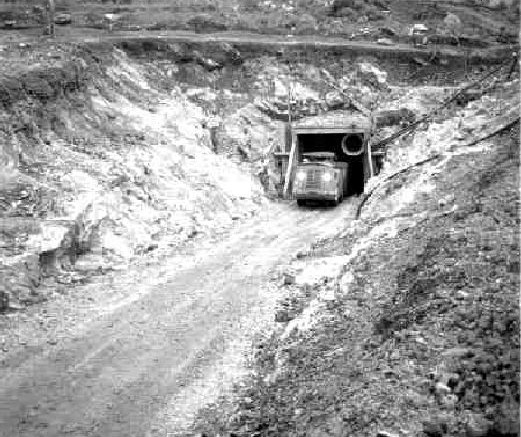
Since the underground program got under way, last November, the decline has advanced a distance of 370 metres to within 75 metres of the main target area. Progress was initially hampered by unstable rock conditions, which slowed advancement and required timber shoring. The decline is being driven at an 8 slope to a depth of 80 metres below surface.
Each round of the mineralized zone will be removed by load-haul-dump machine and brought to surface, where it will be crushed to minus-1-inch size in a 20-tonne-per-hour crushing plant on-site. Eaglecrest anticipates each round will produce about 30 tonnes of material from a 1.7-metre advance.
The crushed material will then be coned and systematically sampled to produce a representative 1-to-2-tonne sample, which will be processed through a 3-tonne-per-hour gravity mill.
“The program will produce bulk-sample numbers that will enable our team of professionals to state, with a high degree of certainty, the grades of the upper three zones in the immediate area tested by the underground work,” states President Gary Cope. “It will also show, by way of crosscutting, the true thickness of these zones.”
The bulk-sampling program is expected to be completed by August. The decline has already passed through two zones of gold-bearing mineralization, reports Eaglecrest, but, owing to crusher maintenance and mechanically related downtime, only two of six rounds of the potential gold zones have been processed so far.
Eaglecrest has about $1 million in cash and 50.6 million shares outstanding, or 59.6 million on a fully diluted basis.
Be the first to comment on "Eaglecrest advances Bolivian gold project"